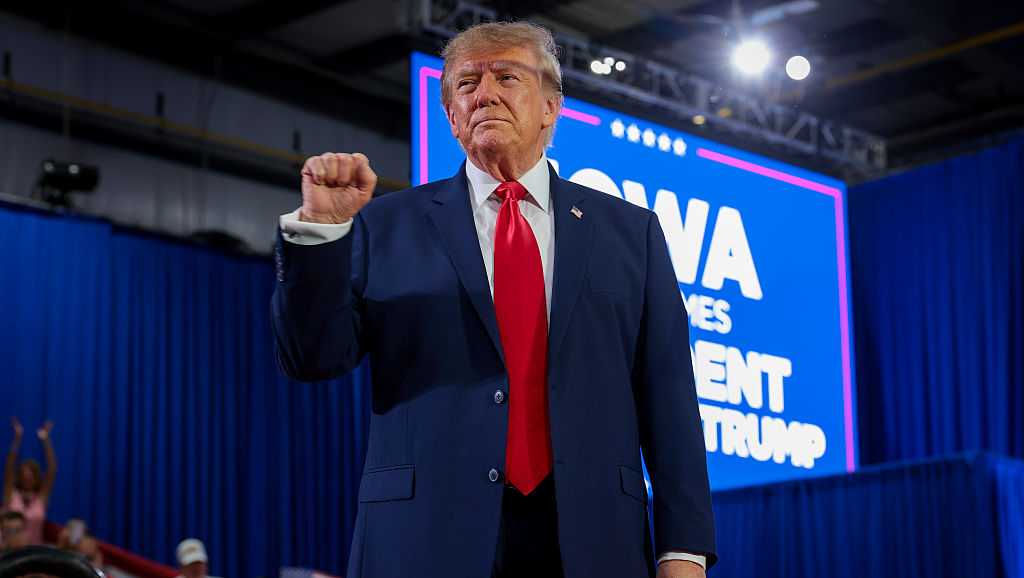
With less than two weeks until the midterm elections, more than 18 million Americans have already cast their ballots — a surge in early voting that is reshaping how campaigns and election offices alike are preparing for the final stretch. As voters head to the polls in record numbers, President Donald Trump is crisscrossing the country to rally supporters in states where Senate control could hinge on a handful of votes.
Trump held a rally Thursday at Sioux City, Iowa, at Sioux Gateway Airport — in Iowa’s conservative northwest corner — as part of a broader campaign swing through states hosting competitive Senate races. The visit is part of a tour that has already taken him through Georgia, Kentucky, Kansas, and North Carolina, with more stops planned in Michigan, Texas, Ohio, and elsewhere before Election Day. Original reporting on the Iowa rally was provided by Iowa Capital Dispatch, AP, and KCCI.
Tight Races, High Stakes for Voters
Iowa’s Senate contest between Republican Rep. Ashley Hinson and Democrat Josh Turek is one of several races that the Cook Political Report has labeled a toss-up — meaning the outcome is genuinely uncertain and voter turnout in the final days could determine the winner. That kind of competitiveness is exactly what makes election participation so consequential: in races this close, every eligible vote carries real weight.
Iowa Republican Party Chair Jeff Kaufmann said Trump is
“anxious for Iowans to hear his message before they vote.”
The president is also expected to return to Iowa on Nov. 1, with a stop in Dubuque.
Hinson, who joined Trump on stage Thursday, is navigating a delicate political balance. She has promised to support the president when his agenda benefits Iowa while also pledging to push back when needed. That balance is complicated by the economic pressures many Iowans are feeling — including manufacturing job losses, healthcare clinic closures, and shrunken farm profits since Trump returned to the White House. At the same time, she is relying on the president’s loyalists to show up and vote for her.
Republican nominee for governor Zach Lahn also appeared on stage with Trump, calling it
“an honor”
to join him. Lahn told the crowd:
“We are here to defend the culture of the United States of America, and Donald Trump is defending that culture.”
Hinson used her stage time to draw a sharp contrast with her Democratic opponent, urging voters
“not to give him that promotion”
and to
“keep Iowa Iowa.”
Trump closed out the nearly 100-minute rally with a direct appeal to his supporters:
“Let’s go out and do what we do best, which is to win.”
The Rally Circuit and What It Means for Voter Turnout
High-profile presidential rallies in competitive states are designed to drive voter enthusiasm and boost turnout among a candidate’s base. In toss-up races — where margins can be razor-thin — a surge of motivated voters on either side can be decisive. But rallies also carry a broader democratic significance: they can increase civic engagement and draw attention to the stakes of a given election, potentially prompting more eligible citizens to participate. Whether that energy translates into votes depends heavily on how accessible the voting process is for those who show up inspired.
Here is a look at Trump’s upcoming rally schedule and how election forecasters are rating each Senate contest:
Trump will rally Friday in Fort Myers, Florida, where the Senate race between GOP Sen. Ashley Moody and Democrat Angie Nixon is rated “solid Republican” by Cook. Saturday brings a stop in Perry, Georgia, where Democratic Sen. Jon Ossoff faces GOP Rep. Mike Collins in a race rated “likely Democrat.” Sunday, Trump heads to Port Huron, Michigan, for an open Senate race between Republican Mike Rogers and Democrat Abdul El-Sayed — another toss-up. Monday brings a stop in Corinth, Mississippi, where GOP Sen. Cindy Hyde-Smith faces Democrat Scott Colom in a race Cook recently moved from “solid Republican” to “likely Republican.” On Tuesday, Oct. 27, Trump holds rallies in both Waco and Lubbock, Texas, where the Senate contest between GOP Attorney General Ken Paxton and Democrat James Talarico is rated a toss-up. He wraps up that stretch Wednesday, Oct. 28, in Chillicothe, Ohio, where GOP Sen. Jon Husted faces Democratic candidate Sherrod Brown in yet another toss-up.
Early Voting Numbers and Election Administration Pressures
According to tracking data from the University of Florida Election Lab, more than 18 million Americans had already voted early as of Thursday morning. That volume puts significant demands on local election offices, which must process, verify, and securely store ballots well before Election Day — and often with limited staff and resources. High early-voting participation can be a sign of civic health, but it also tests the administrative capacity of election systems to handle ballots accurately and efficiently, and to report results in a timely manner once polls close.
Meanwhile, the broader political environment is shaped by Trump’s approval numbers. A Times/Siena University national poll found that only 36% of likely voters approved of Trump’s job performance. A separate CNN/SSRS poll put that figure even lower, at 32%. Analysts point to the ongoing war in Iran and its economic ripple effects as significant factors — AAA reported that the national average price for a gallon of regular gas stood at $4.26 as of Oct. 21, up sharply from about $3.05 a year earlier.
Election forecasters are also growing more skeptical of Republican prospects overall. Sabato’s Crystal Ball at the University of Virginia Center for Politics moved nearly 30 House races toward Democrats on Tuesday, reflecting a broader trend that analysts say favors Democrats retaking the House majority. Republicans are also working to hold their narrow Senate majority, with a growing number of races shifting toward competitive territory.
Public trust in elections is shaped not just by how campaigns are run, but by whether voters feel their participation matters and that their ballots will be counted accurately. With millions already voting and contested races across multiple states, election officials face the dual challenge of managing a high-volume election while maintaining the transparency and security that sustain confidence in the democratic process.