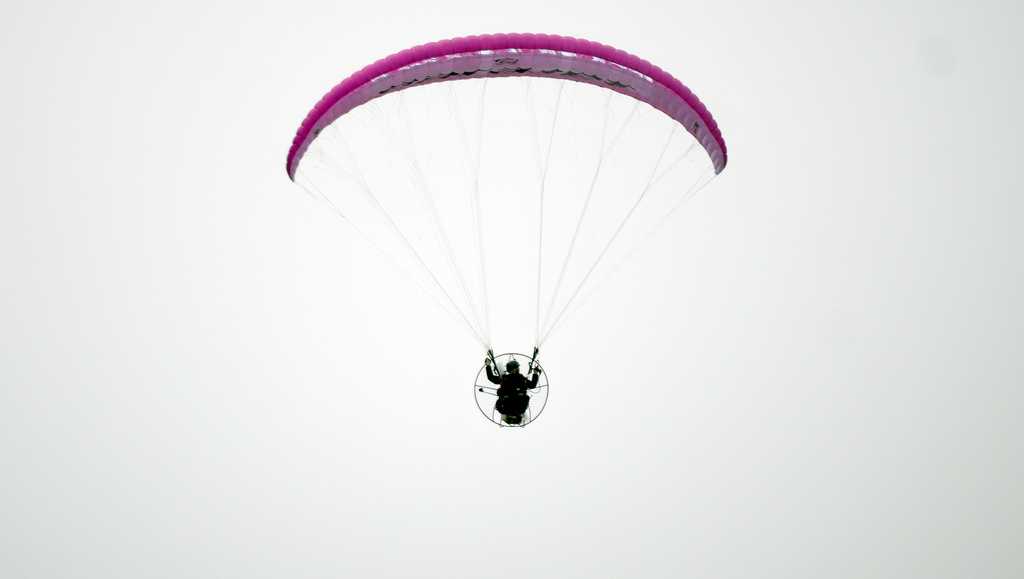
Most people complain about their morning commute. Jake Hutzler has turned his into something that sounds like a dream — strapping a propeller to his back and lifting off into the Colorado sky, flying to the airport tower where he spends his days guiding planes safely to the ground.
Hutzler, 28, is an air traffic controller at an airport near Pueblo, Colorado, a city tucked close to the Front Range mountains. Once a week, weather permitting, he commutes to work by paramotor — a motorized backpack unit attached to a large parachute-like wing that lets a person fly under their own power at low altitudes. The story was first reported by Hallie Golden and Thomas Peipert.
The routine starts outside his apartment complex, where he lays the wing flat on the road, fires up the motor, and begins running. Within seconds, his feet leave the ground. For the next 20 minutes, he cruises at about 35 mph over open fields, crossing above a highway and a water tower before the airport comes into view.
A Bird’s-Eye View Unlike Any Other
Hutzler grew up fascinated by flight. His grandfather regularly took him up in a small four-seat aircraft, and in college he logged about 20 hours toward a private pilot’s license before the expense made it impossible to continue. That changed when he stumbled across a viral video of someone flying a paramotor to McDonald’s and eating a hamburger on the way home.
He said:
“After I saw that, I was like, ‘I’m sold. I gotta do that.'”
What makes paramotoring so appealing to many people is its accessibility. No pilot’s license is required, and the cost is far lower than most other forms of aviation. The sport is still subject to federal regulations governing ultralight vehicles — pilots must fly only during daylight hours and must stay clear of congested areas — but for those who qualify, the barrier to entry is relatively low.
For Hutzler, the experience offers something that no cockpit can replicate.
“In a paramotor, you have a view that almost nobody gets to experience,”
he said.
“You have no cockpit, nothing in front of you. You’re just sitting there in the air and total freedom to go wherever you want.”
Flying Became Part of His Whole Life
Hutzler began training to fly paramotors — also called powered paragliding — in 2021 in Florida and eventually became a certified instructor. The sport wove itself into nearly every part of his personal life as well. He trained the woman who would become his wife, and when the time came to propose, he used a staged engine problem on his paramotor to draw her to the equipment, where he had hidden an engagement ring. At their wedding, both paramotors stood at the altar alongside them. Now the couple has a 2½-year-old daughter, and Hutzler is already looking forward to the day she’s old enough for a tandem flight.
When he began working in air traffic control earlier this year, his schedule left less room for flying. His solution was straightforward: fly to work.
He discussed the idea with his manager, and together they reviewed the regulations. The key requirement was that Hutzler maintain two-way radio communication with the tower whenever he entered controlled airspace. He made his first paramotor commute in June and has continued doing it on a weekly basis since then.
Before each flight, he calls the tower to let his colleagues know he’s on his way. Once airborne, he checks in regularly with updates on his position and altitude.
“I’m very small, and I don’t show up on radar,”
he said,
“so they’ll want to kind of keep track of my location and get updates on my progress.”
When the airport comes into sight, he waits for clearance before descending onto the ramp, slowing himself with hand toggles and landing with a short jog. He then packs up his equipment, removes his flight jacket to reveal the collared work shirt underneath, and heads in to start directing air traffic.
Not Faster — But Far More Fun
The paramotor commute is not actually quicker than driving. Setup and pack-down time means the total trip takes slightly longer than simply getting in a car. But speed is not the point.
“You could be having your favorite song playing in your headphones, and you just can relax and take in this awesome experience,”
Hutzler said.
Weather is the biggest limitation. Even a light breeze of around 10 mph is enough to keep him grounded. Solar heating of the ground can also create unstable updrafts that make for a rough and potentially dangerous ride. On those days, he drives like everyone else.
Want to follow more offbeat and uplifting stories like this one? Subscribe to the News We Love newsletter here.