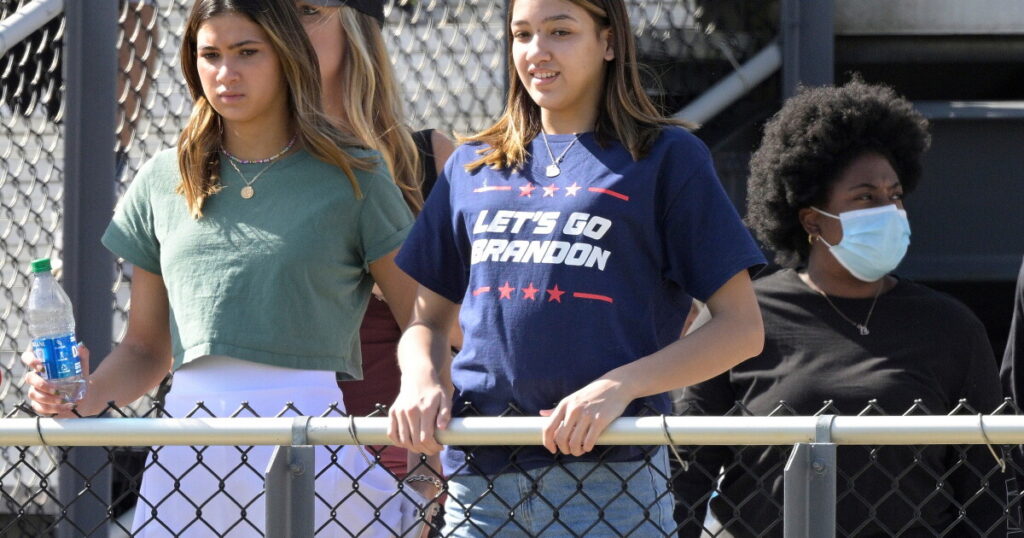
A Christmas gift turned into a constitutional clash — and now the nation’s highest court has had the final word. The U.S. Supreme Court has declined to take up a case from a Michigan mother who argued that her sons’ First Amendment rights were violated when their school banned them from wearing “Let’s Go Brandon” sweatshirts.
The Michigan woman purchased the sweatshirts as Christmas gifts for her two boys in 2022. When they wore them to school, they were told to remove the garments. She sued the school district, contending the ban amounted to an unconstitutional suppression of political speech. Her attorneys argued that school officials were overstepping their authority by restricting expression based on their own judgments about what is inappropriate — particularly when the phrase contains no explicit language or sexual content.
The school district pushed back, maintaining that clothing carrying implicit crude messaging does not belong in a school environment, even when it touches on political subjects. Officials also noted that some students wore pro-Trump clothing, including “Make America Great Again” gear, referencing President Donald Trump, a Republican who lost the 2020 election to Biden, a Democrat.
A federal appeals court sided with the school district, ruling that the phrase’s underlying meaning — widely understood as a substitute for “F— Joe Biden” — gave the school sufficient grounds to enforce the ban. The court found that the phrase’s indirect but clear profane meaning distinguished it from ordinary political speech. That ruling, covered under the Politics & Government beat, set the stage for the Supreme Court appeal.
How a NASCAR Moment Became a Political Rallying Cry
Brandon Brown, a NASCAR driver, unwittingly lent his name to one of the most recognizable political phrases of recent years. After Brown won a race in 2021, the crowd erupted in an obscene chant directed at then-President Biden. When a TV sports reporter narrated the scene, she apparently believed the fans were cheering Brown’s name, telling viewers they were shouting “Let’s Go, Brandon.” The moment, captured live on air, quickly spread across social media and was embraced in conservative circles as a thinly disguised way to express the original profane sentiment.
The phrase’s rapid cultural rise drew attention well beyond sports arenas. A Southwest Airlines pilot was investigated after using it during a flight, as reported by Deepa Shivaram, with the airline stating it does not condone employees sharing personal political opinions while on duty. The phrase also found its way into Congress, underscoring how far it had traveled from the racetrack.
With the Supreme Court’s refusal to hear the case, the appeals court’s decision stands, leaving in place a legal standard that permits schools to restrict phrases carrying an implied profane meaning — even when those phrases are also understood as political commentary. The case adds another chapter to the ongoing national debate about where the boundaries of student speech rights lie, a topic as the Supreme Court faces another term packed with controversy involving speech, education, and individual rights.
The core question the case raised — whether schools can ban politically charged language that implies but does not explicitly state profanity — remains a live tension in First Amendment law, even as this particular dispute comes to a close.