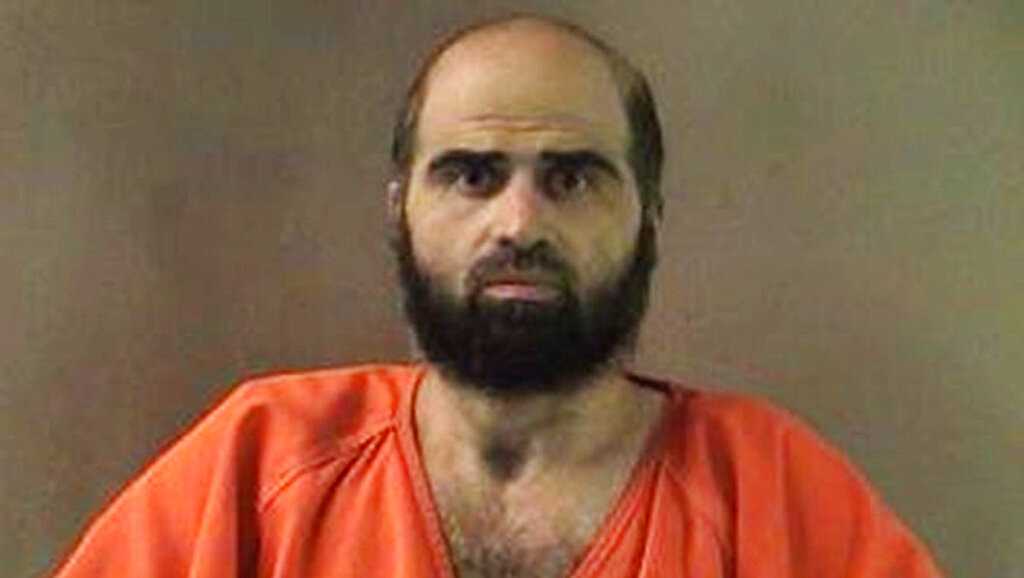
For the first time in more than six decades, the United States military is preparing to carry out an execution — and this one will be broadcast live for the public to watch. The Pentagon confirmed Thursday that the firing squad execution of Fort Hood shooter Nidal Malik Hasan will be livestreamed, raising a wave of legal, ethical, and policy questions from experts across the country.
The Army announced that the execution would take place at Fort Hood on December 3. Hasan was convicted of killing 13 people and wounding 32 others in a mass shooting at the Texas military base in 2009 — one of the deadliest attacks ever carried out on a U.S. military installation.
Defense Secretary Pete Hegseth first signaled the public nature of the execution during an appearance on the conservative outlet Real America’s Voice, saying,
“We’ll make sure that people are able to watch it, that it’s public.”
Pentagon officials clarified the following day that livestreaming was the specific method being planned, with more details to come.
President Trump, who approved Hasan’s execution, has said little publicly about the livestreaming plan. The White House referred all related questions to the Pentagon. When Hegseth was asked Wednesday whether Hasan had made any final requests or reached out to the administration, the Defense Secretary replied:
“Don’t care. We’ll see him on Dec. 3.”
What Experts Are Saying
Legal scholars and death penalty experts have offered sharply different views on the plan. The announcement has also renewed broader debate about how the death penalty is carried out in the U.S., particularly in the wake of the botched lethal injection of Christa Pike in Tennessee.
Deborah Denno, a death penalty expert and law professor at Fordham University, said that broadcasting an execution could serve a public interest. She noted that Pike’s botched execution had already reopened national conversations about how prisoners are put to death.
“I think it could possibly be a good idea because it would be transparent and the public would be fully aware that it’s happening,”
she said, adding that livestreaming could make the process
“much more transparent”
and better inform the public about what capital punishment actually involves.
Brenner Fissell, a professor at Villanova Law and vice president of the National Institute of Military Justice, noted that firing squads have gained renewed consideration as states have struggled with lethal injections due to drug shortages and difficulty finding willing medical professionals.
“Firing squads can be a quicker, cleaner, more precise way to execute a prisoner,”
he said. But he questioned the motivation behind this particular choice:
“I don’t think that’s what’s motivating this. There’s a perceived masculinity and military-ness to firing squads that is part of the aura Hegseth is trying to emphasize — the ‘lethality culture.'”
Elisabeth Semel, co-director of the Death Penalty Clinic at UC Berkeley Law, raised concerns about the dignity of the defendant, who has access to witness the execution, and what broader message the administration is sending. While public debate about televising executions has existed for years, she said this situation is different.
“I don’t recall a situation in which it was instigated by the government. I think that also raises serious questions about what is the motivation of the government,”
she said. Semel added:
“This is a president who’s about spectacle and that’s, I think, precisely the message that he intends to deliver,”
saying she doubted the administration had seriously considered the legal and social implications of its decision.
Eugene R. Fidell, a visiting lecturer at Yale Law School specializing in military law, pointed out that Hasan could still pursue legal avenues to delay the execution — including filing a habeas petition challenging the legality of his detention in civilian court.
“It frankly might outlast the current administration, and who knows if the next one will have the same penchant for executions,”
Fidell said.
A Contradiction on Public Executions
The decision stands in notable contrast to statements Trump has previously made about public executions abroad. In January, Trump told reporters:
“We’ve been told that the killing in Iran is stopping. It’s stopping, and there’s no plan for executions.”
In his State of the Union address, he also stated:
“We stopped them from hanging a lot of them with the threat of serious violence.”
Amnesty International’s report on executions in 2025 recorded at least 17 public executions worldwide — 11 in Iran and 6 in Afghanistan.
Who Is Nidal Hasan?
Hasan was an Army psychiatrist holding the rank of major when, on November 5, 2009, he entered a medical building at Fort Hood where soldiers were waiting in long lines for immunizations and medical clearance before deployment. He shouted “Allahu akbar” — Arabic for “God is great!” — and opened fire with a laser-sighted handgun, also shooting at soldiers fleeing toward the parking lot. He was shot by law enforcement and has used a wheelchair since, paralyzed from the waist down.
At his 2013 trial, Hasan fired his lawyers and represented himself, opening by telling the jury he was the shooter. He called no witnesses and made no closing argument. A military judge barred him from arguing that the attack was an effort to prevent soldiers from going to Afghanistan and killing fellow Muslims. Documents leaked during trial revealed Hasan had told military mental health workers he could
“still be a martyr”
if executed — a statement that led his standby attorneys to conclude his only goal was a death sentence.
Questions About Legal Counsel and Process
Attorney John Galligan, a former military judge who has represented Hasan in civil matters since his criminal trial, said he spoke with Hasan on Wednesday but is limited in what he can disclose. He raised concerns about Hasan’s physical health and the circumstances under which Hasan was formally notified of Trump’s decision. According to Galligan, when Hasan was told that Trump had signed off on his execution, a chaplain was brought — but no attorney from either the Trial Defense Service or his civilian defense team. Galligan said that constitutes a breach of Army regulations.
A spokeswoman for the Army disputed that characterization Thursday, saying multiple attempts were made to contact Trial Defense Service attorneys and that
“every reasonable effort”
was made to adhere to policy.
“The civilian counsel was not reasonably available to be physically present for the notification on the 5th,”
she said, noting the attorney was located in Virginia. The spokeswoman also stated that Hasan has not been prevented from contacting or communicating with legal counsel.
Hegseth confirmed that the military has not executed a service member by firing squad since World War II. The last military execution of any kind occurred on April 13, 1961, when Army Pvt. John Bennett was executed by hanging.