On a remote island in Lake Michigan, accessible only by a 30-minute ferry ride, one in four school-aged children is being educated at home — and the story of why reveals something important about where American education is heading. Homeschooling has quietly reached record levels across Wisconsin, reshaping communities and challenging long-held assumptions about who chooses this path and why.
Wisconsin Watch reporting from Washington Island — a tight-knit community of about 800 people situated 7 miles off the Door County peninsula — offers a close-up look at how the national homeschooling surge is playing out in one of the state’s most unusual settings. The island’s outsized homeschooling rate, which far exceeds the statewide average of 6%, reflects a broader trend: homeschooling in Wisconsin has climbed for three consecutive years following a pandemic-era spike, now hitting its highest point since the state began collecting data in 1984. The growth comes as public school enrollment falls and private school enrollment holds flat.
According to data tracked by researchers, more families across the country are making the same choice — and their motivations are far more varied than conventional wisdom suggests.
Who Is Actually Homeschooling?
Angela Watson, director of the Johns Hopkins Homeschool Research Lab, says public perception hasn’t caught up with reality.
“When I say ‘homeschoolers,’ most people are going to think of these really persistent stereotypes: the mom at the kitchen table with all of the kids … They’re very religious, conservative, whatever. And then there are concerns about, ‘It’s isolationism and indoctrination, and maybe even educational neglect and abuse.'”
Watson said those cases exist but represent a fringe. Her research finds that homeschooling families closely mirror the broader U.S. population in race, ethnicity, income, education level, and geography.
Watson also pushes back against the idea that homeschooling is primarily a rejection of public education.
“(Many) think that people are homeschooling as this rejection of traditional schooling and particularly traditional public schooling. This is much more dynamic than what people give it credit for and that these families are trying to get their needs met for their kids and for their families for particular things.”
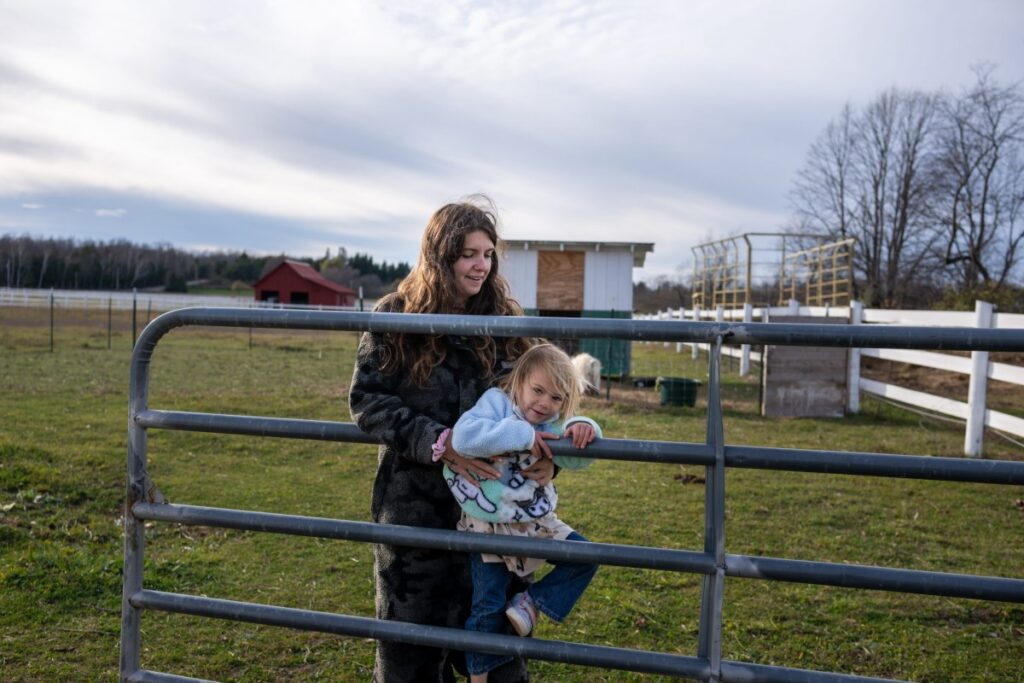
On Washington Island, that rings true. Hannah Dusik moved back to the island six years ago with her husband, settled into a farmhouse with a hobby farm, and decided to homeschool her four children. Her reasons were rooted in a desire for a slower, more intentional life — not opposition to the local school.
“I think it’s important for people to think that kids also deserve some sense of freedom, and I think that homeschool gives them a little bit of that,”
Dusik said.
Cheyenne Watkins, another island parent who homeschools four children, cited a mix of factors: religious values, concerns about how staff might address topics like gender, the joy of watching her children learn, and above all, the freedom to travel and visit family.
Marisa Kehren, who holds a teaching degree, homeschools her five children partly because her husband’s FBI career kept the family moving across the country. She also values being able to teach her kids the Bible and provide more individualized support for her oldest child, who has Down syndrome. But her core reason is simpler.
“The main reason, I guess, that we haven’t sent our kids is because then (they) won’t be hanging out with me,”
Kehren said.
Kehren says she approaches homeschooling
“year by year,”
and hasn’t ruled out enrolling her children as they get older.
“Each kid has their own personality and goals and wishes and dreams, and we take that into consideration and try and work with them in a way where everybody’s at least remotely happy,”
she said.
The Financial Reality for Public Schools
For Tim Verboomen — who serves as the Washington Island School District’s administrator, curriculum director, and athletic director — every child educated at home represents real money the district doesn’t receive. Wisconsin school funding is tied in part to enrollment, meaning a homeschooled child is a child the district cannot count.
“There’s between a quarter million and a half million dollars out there that we could bring in if we could get those kids into our building,”
Verboomen said.
The district has sought voter-approved referendums to close budget gaps and even crowdfunded for a new gymnasium. The school building has capacity for every island child. Verboomen is blunt about the economics.
“We could teach twice as many kids as we currently have in our building for almost no additional expense. We have all the teachers paid for already. We already have the lights on. We’re paying for the heat already. We would have to buy more toilet paper, and you know maybe a little more cleaning supplies and whatever, but very minimal expense to get more people in.”
Recruiting and retaining teachers is its own challenge. The island’s remote location and high housing costs make it hard to attract qualified educators. The school’s 15 teachers each handle multiple grades or subjects, and Verboomen has relied on emergency licenses to fill gaps.
“We’ll do whatever,”
he said.
“I’ve had to be shameless.”
This financial pressure is not unique to Washington Island. Across Wisconsin, public schools are grappling with similar dynamics as homeschooling grows. Related reporting from Wisconsin Watch highlights other stress points in the state’s education system, including students with disabilities being denied public school choices, nearly half of private school students receiving taxpayer-funded vouchers, unintended consequences from the state’s college admissions law, and nearly half the students at one university still being in high school.
Coexistence, Not Conflict
Despite the financial tension, Washington Island homeschooling families and the public school have found ways to coexist. Under Wisconsin law, public schools must allow homeschoolers to take up to two classes per semester, and schools receive partial funding for those students’ time in class. Homeschoolers may also participate in sports and extracurricular activities.
Watkins’ 12-year-old daughter plays on the school soccer team and attends school dances and dinners. Kehren’s children participate in chess club and team sports. Some older homeschooled students sign up for advanced math or science courses that are harder for parents to teach at home.
Verboomen’s strategy is to make the school so welcoming that homeschooled children ask their parents to enroll.
“I want their kids to get here and be like, ‘Mom, I want to go back. I want to be here.’ I want them to be in school. That’s my job. It’s just personal, right?”
he said. Not all district board members agree with this open-door approach — some believe limiting access to enrolled students only would bring more families in — but Verboomen stands by it.
“I mostly would believe that if we are a place that they want to be at, that that’s our best chance,”
he said.
Watson says this shift in attitude is happening more broadly. Public schools are starting to recognize that homeschool families are
“more pragmatic”
than the old stereotypes suggest, and the relationship between the two is becoming less
“adversarial.”
“Because of necessity, right, (public schools are) changing their attitude a little bit. It helps the homeschooled students because now they can play football or take chemistry, and it helps the schools because they can recoup some of these students that they would otherwise not be getting funding for,”
Watson said.
When Homeschooling Doesn’t Go as Planned
Hannah Dusik’s story adds an honest counterpoint to the idealized image of homeschooling. After years of educating her children at home, she found herself struggling. Her children resisted her teaching. Sibling arguments eroded the peaceful family time she had envisioned. Her son needed more structure than she could provide.
She enrolled them in the island school.
“I can’t keep them in a bubble, which has been very difficult for me. You need to start to let them go a little bit. So these are my baby steps,”
she said.
The results surprised her. Her oldest, a sixth grader who had struggled with anxiety, has
“come out of her shell more”
since starting school. Dusik described feeling
“humbled”
by her children’s progress — and conflicted after years of seeing polished homeschooling content online.
“Sometimes it just doesn’t work how you want it to. You see the highlights on social media and Instagram, but it just doesn’t always go like that. Even with how badly you want it to,”
Dusik said.
She hasn’t closed the door on homeschooling permanently.
“I still have the mentality of sticking it to the man. I don’t like the system, like in general. I feel like they need more than what I can handle right now. So I’m using these amazing people that I trust as a tool to help us through this season,”
she said.
Her experience reflects what researchers and educators are seeing nationally: homeschooling is rarely a permanent, all-or-nothing decision. Families move in and out of the system, piecing together what works best for each child — a reality that may reshape how communities think about the relationship between homeschooling and public education for years to come.