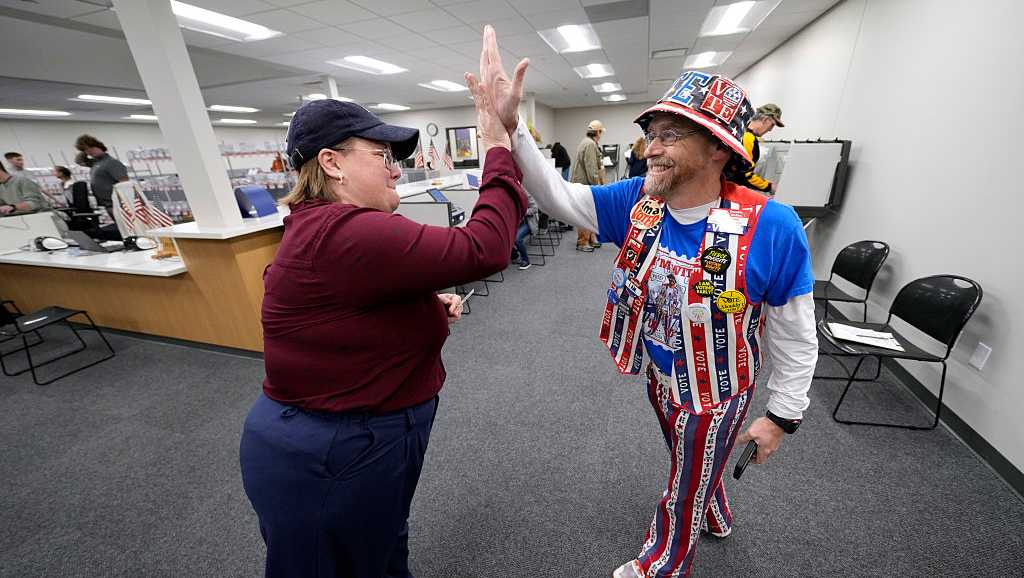
Iowa is at the center of one of the most consequential election cycles in recent memory, with control of the U.S. Senate and House both potentially hinging on how voters in the Hawkeye State cast their ballots Tuesday. For everyday Iowans, this election isn’t just about party labels — it’s about who represents them in Washington and who steers their state for years to come.
The political landscape in Iowa has shifted dramatically over the past decade. Once a genuine presidential battleground, the state has trended sharply Republican, with former President Donald Trump carrying Iowa three times — most recently in 2024 by a 13-point margin. It has been more than a decade since Iowans sent a Democrat to the governor’s mansion or the U.S. Senate, and 24 years since they elected Democrats to both offices in the same year. Yet this cycle, with two major Republican officeholders stepping aside, the competitive dynamics look different. Voters can check sample ballots for their area to see exactly what’s on their ballot before heading to the polls.
What’s Being Decided — and Why It Matters
Governor Kim Reynolds and U.S. Senator Joni Ernst are both retiring, opening up two of Iowa’s most powerful offices at the same time. Those retirements have set off a chain reaction across the ballot, reshaping multiple races simultaneously.
In the U.S. Senate race, Republican Rep. Ashley Hinson faces Democratic state Rep. Josh Turek. Ernst’s 2014 Senate win helped Republicans secure control of the chamber for the final two years of President Obama’s administration. A Turek victory could flip that script — potentially giving Democrats the same kind of leverage over the remainder of President Trump’s second term.
Turek has significantly out-fundraised Hinson, bringing in roughly $18 million since July 1 compared to about $3.9 million for Hinson. But campaign finance totals don’t tell the whole story of what voters will actually see and hear. A super PAC connected to Republican Senate Majority Leader John Thune has poured approximately $36 million in advertising into Iowa on Hinson’s behalf, according to the ad tracking firm AdImpact — illustrating how outside money can reshape the information environment for voters even when a candidate’s own fundraising lags.
For governor, Republican entrepreneur Zach Lahn — who co-founded a private school and upset the Trump-endorsed candidate, Rep. Randy Feenstra, in the June primary — faces Democrat Rob Sand, Iowa’s state auditor and the only Democrat currently holding statewide elected office. Sand was unopposed in the Democratic primary.
Competitive Congressional Seats in Play
Hinson’s move to run for Senate created an open seat in Iowa’s 2nd Congressional District, which she had won with 57% of the vote in 2024. This year, that seat ranks among the most competitive in the country.
In the 1st Congressional District, Republican Rep. Mariannette Miller-Meeks faces a rematch against former state Rep. Christina Bohannan, who came within just 1 percentage point of defeating her in 2024 — one of the closest U.S. House races in the nation that year. In the 3rd District, Republican Rep. Zach Nunn faces Democratic state Sen. Sarah Trone Garriott. Trump received roughly 54% of the 2024 presidential vote in the 1st and 2nd Districts, and about 52% in the 3rd District. Trump campaigned for Hinson, Lahn, and other Republican candidates at a rally in Sioux City on October 22.
Where to Watch the Numbers
Understanding how Iowa counts its votes can help citizens follow election night results and trust the process. Iowa does not have an automatic recount law, but candidates for statewide and federal offices can request one if the winning margin is less than 0.15% of total votes cast. For all other offices, the threshold is less than 1% of the vote or 50 votes, whichever is smaller.
Polls close at 8 p.m. CT. In the 2024 election, the Associated Press reported its first results just one minute after polls closed, with the count reaching the halfway point by 9:33 p.m. and approximately 99% of total votes tallied by 2:20 a.m.
About 30% of Iowa’s vote in the 2022 midterm Senate race was cast early — either in person or by mail. This year, early voting numbers have broken records in Polk and Dallas counties. Voters can track early voting totals for Iowa as results come in.
For counties like Polk, Scott, and Black Hawk — Iowa’s three largest — the first vote reports of the night are expected to include results from all vote types. In Linn, Johnson, and Dallas counties, early in-person and mail results are expected before in-person Election Day counts are released. Roughly nine out of ten counties statewide are expected to release nearly all of their absentee results in their first updates of the night.
The AP will declare a winner only when it determines there is no realistic scenario in which a trailing candidate can close the gap — not based on projections, but on verified vote counts. About 1.2 million votes were cast in Iowa’s 2022 U.S. Senate race, providing a baseline for understanding turnout this cycle.
Which Communities Will Shape the Outcome
Iowa’s political geography is well established: Democratic candidates tend to run strongest in population centers like Des Moines (Polk County), Cedar Rapids (Linn County), Iowa City (Johnson County), Ames (Story County), and Waterloo (Black Hawk County). Republicans build wide margins in more rural areas and tend to perform well in Woodbury County in western Iowa.
Two counties deserve particular attention as bellwethers: Dallas County, home to West Des Moines, and Scott County, which includes Davenport. Trump narrowly carried Dallas County all three times he ran, never exceeding 51% there. In his 2022 state auditor reelection campaign, Sand carried Dallas County by about 7 percentage points and narrowly lost Scott County. Vice President Kamala Harris lost Scott County by a wider margin in 2024, though Democrats Hillary Clinton and Joe Biden both edged Trump there in 2016 and 2020, respectively. How these two counties perform Tuesday night will likely be an early indicator of where the statewide races stand.
The full scope of what Iowa voters are deciding — including U.S. Senate, U.S. House, governor, secretary of state, state auditor, treasurer, agriculture secretary, attorney general, state legislative seats, and a statewide ballot measure — reflects just how much democratic decision-making happens in a single election cycle. Every race on the ballot represents a choice about who holds power and how that power is used on behalf of ordinary Iowans.