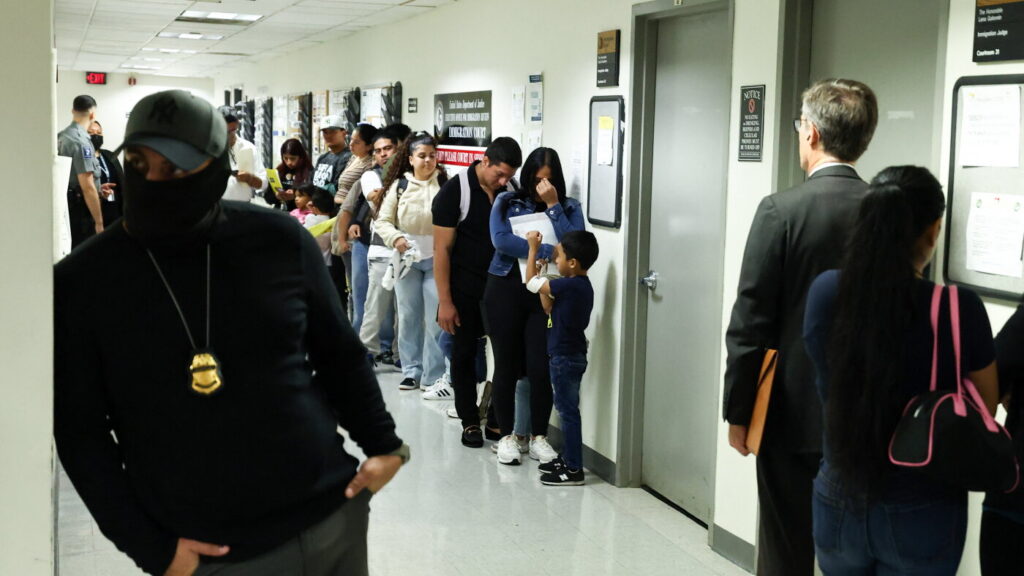
Federal immigration courts have begun scheduling deportation hearings at previously unannounced government buildings, sometimes alerting immigrants to the change within days of a new court date — and in at least two documented cases, sending no mailed notice at all.
Over the past several weeks, immigrants with hearings scheduled at courts in Maryland and Virginia have been rerouted to two locations that carry no public designation as immigration courtrooms: a Falls Church, Va., building that houses the Executive Office for Immigration Review’s own headquarters, and a Washington, D.C., facility that one government source told NPR is listed as occupied by the Federal Emergency Management Agency — not the Justice Department.
Kel White, an officer of the D.C. chapter of the American Immigration Lawyers Association, attended a hearing at the Falls Church site on September 2. She called it “the most unusual thing I’ve ever seen” in more than 15 years of practice. The immigration judge and a Department of Homeland Security attorney appeared on screens from remote locations while immigrants were required to show up in person. White told NPR the short-notice relocations violate Justice Department regulations that require at least ten days’ notice before a new hearing date.
The legal stakes for missing a hearing are severe. Under federal immigration law, a judge may issue a deportation order against anyone who fails to appear — even unknowingly. Attorneys told NPR the rescheduled hearings appeared to target immigrants without legal representation, the group least likely to catch a last-minute location change and least equipped to challenge a deportation order after the fact. Most people in immigration court proceedings do not have lawyers.
One person whose case was moved to Falls Church told NPR they discovered the change through a phone app called MigraConnect — two weeks before the new date — because no mailed notice had arrived. The hearing had been scheduled for December at a Virginia court; it was moved without explanation to September 2 at the new location. “Thank God I had that application,” the person said, “because without it they would have put me on a path to deportation.”
The consequences are already visible in the data. In Baltimore’s immigration court, the share of unrepresented immigrants receiving in-absentia removal orders has climbed from 54 percent in January to 73 percent in June, according to Mobile Pathways, a nonprofit that tracks immigration court records, as reported by NPR. Nationally, in-absentia removal orders jumped from roughly 35,000 in May to 54,000 in June, according to data cited in The Hill by a former congressional immigration counsel writing in August.
The undisclosed-location tactic compounds an already destabilized adjudication system. More than 200 immigration judges have been fired, retired, or forced out in the past 14 months, CBS News reported, with many replaced by “deportation judges” drawn from enforcement backgrounds. By February, just 5 percent of asylum applicants won their cases — a historic low, according to the Transactional Records Access Clearinghouse — down from 31 percent a year earlier. A former appellate immigration judge and Brennan Center fellow writing in The Hill in July warned that the administration’s procedural tactics are “whittling away at immigrants’ due process rights” — rights that, under the Fifth Amendment, extend to every person on U.S. soil.
The Executive Office for Immigration Review said in a statement that it “will continue to make scheduling adjustments, to include opening new hearing locations as needed, to ensure all cases are handled in a timely and lawful manner.” The agency did not respond to NPR’s questions about why the locations were shifted without public announcement, or why immigrants were not being reliably notified by mail.
A hearing at the D.C. Federal Center Plaza location — a building with no listed Justice Department affiliation — is scheduled to begin September 9.
“My concern about these hidden tribunals,” White told NPR, “is that essentially people are not getting notice of them or that the mail would not arrive in time for them to even know that they need to go to court.”