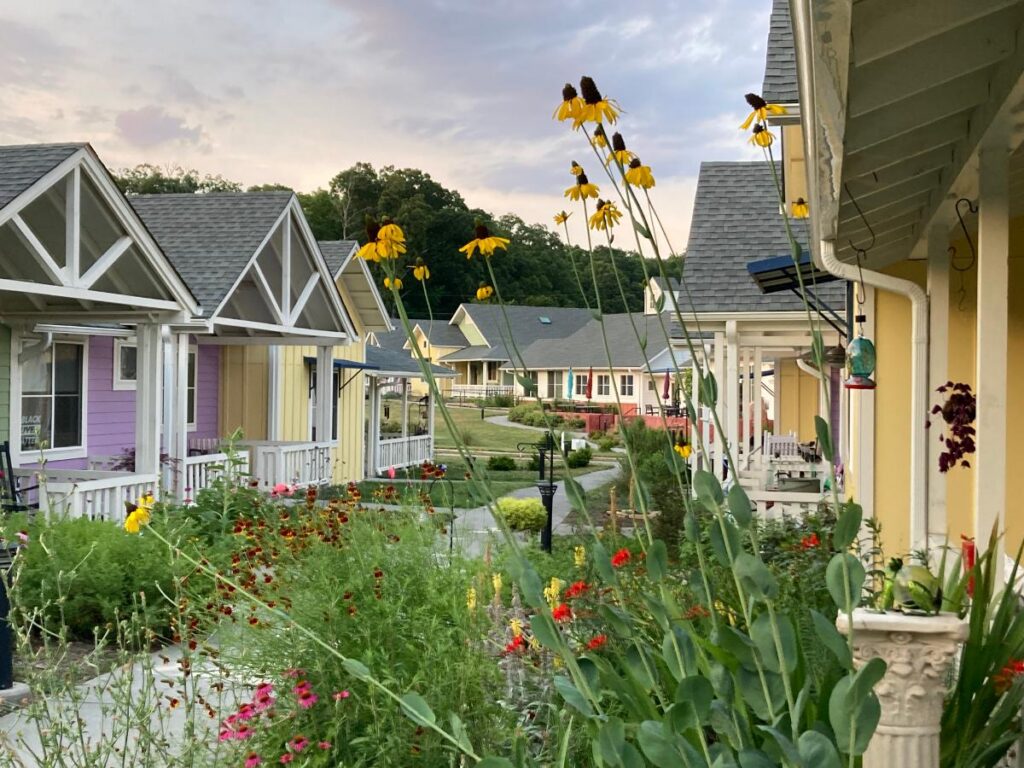
DURHAM, N.C. — When Village Hearth opened in Durham in 2020 as what is widely recognized as the first LGBTQ+ senior co-housing community in the United States, its founders wanted to solve a problem long discussed but rarely resolved: how to age in community without hiding who you are.
Nearly 30 homes sit on 15 wooded acres in Durham. They represent something modest in scale but significant in what they illuminate: a population with acute health disparities, limited access to affirming care, and a federal policy environment that advocates say is growing more hostile.
Kristin Chervenak moved to Village Hearth with her wife in October 2025, coming from Louisville, Kentucky. She described a change she hadn’t anticipated: she felt lighter. “Thinking back on it, there’s always just a little bit of guardedness …” she told North Carolina Health News. “And I don’t think I realized how heavy that weight was until I came here and it wasn’t there anymore.”
That guardedness has measurable health consequences. A University of Michigan National Poll on Healthy Aging, cited in the NC Health News report, found that 20 percent of LGBTQ+ adults over 50 reported a lack of companionship in the past year, compared with 8 percent of non-LGBTQ+ adults in the same age group. The same poll found that 19 percent of LGBTQ+ adults older than 50 reported poor or fair mental health, compared with 11 percent of other seniors.
The broader picture is equally stark. An estimated 2.7 million LGBTQ+ Americans are over age 50, according to Justice in Aging, a national legal advocacy organization focused on senior poverty — a number that Justice in Aging, citing advocacy estimates, says will grow to 7 million by 2030. A first-of-its-kind California state survey of more than 4,000 LGBTQIA+ residents aged 50 and older found that one in five rated their mental health as fair or poor and 11 percent reported serious thoughts of suicide in the past year.
Karen Cushing, director of business development at SAGECare — the credentialing and training arm of SAGE, the national LGBTQ+ elder advocacy organization — said older LGBTQ+ adults carry decades of accumulated trauma, including the impact of the many deaths during the 1980s AIDS epidemic. Providers without training in LGBTQ+ affirming care, she told North Carolina Health News, often create environments where patients do not feel safe being honest about their lives.
“What is life-saving for many of our older LGBTQ adults is community, but it’s also affirmative providers,” said Christian D. Chan, UNC Greensboro associate professor.
The stakes of that gap are compounded by financial vulnerability. LGBTQ+ older adults are twice as likely as their non-LGBTQ+ peers to rely on Medicaid as their primary source of health coverage, according to Justice in Aging. That dependency places them squarely in the path of H.R. 1, enacted last year, which cut Medicaid spending by more than $900 billion over ten years and added work requirements that the organization says would strip coverage from more than 5 million people who are not yet 65 and do not qualify for an exemption.
Federal protections within aging services face a separate threat. Regulations updated in 2024 under the Older Americans Act formally designated LGBTQ+ older adults as a population of “greatest social need,” directing additional federal resources toward their care. According to SAGE’s government affairs director Aaron Tax, speaking at a joint webinar with Justice in Aging and Lambda Legal, the Trump administration is expected to reopen those regulations for the sole purpose of removing that LGBTQ+ designation — a move the organizations say has no substantive justification and is “purely based on animus.”
At Village Hearth, Thursday-night communal dinners, shared governance, and a commitment to open communication form the texture of daily life. Co-founders Pat McAulay and Margaret Roesch say the co-housing model is replicable. The policy ground on which they built it is increasingly uncertain.