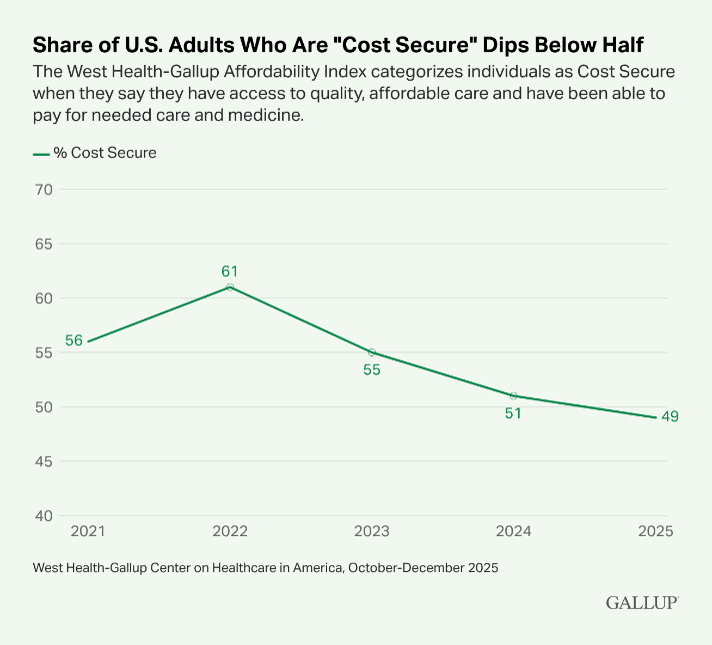
For the first time in five years, most Americans cannot consistently afford their own health care — a threshold researchers say reflects the combined weight of surging insurance premiums, expired federal subsidies, and structural inequities that hit the most vulnerable hardest.
New data from the West Health-Gallup Healthcare Affordability Index shows only 49% of U.S. adults are now “Cost Secure” — meaning they can access quality care and pay for visits and prescriptions without financial hardship. That is down from 56% in 2021 and the lowest point since the index launched. An estimated 2.8 million Americans fell out of the cost-secure category in a single year.
“The fact that fewer than half of Americans can reliably afford healthcare should alarm every person, policymaker and healthcare leader in the country,” Tim Lash, president of West Health, said in the report’s release.
The decline is steepest among those with the least room to absorb it. Black adults are cost-secure at a rate of just 38% — a drop of 16 percentage points since 2021. Hispanic adults stand at 32%, down 19 points. Young adults between 18 and 29 are now cost-secure at 32%, down from 46%. Gallup’s survey of 5,660 U.S. adults also found that roughly one in five households earning more than $180,000 annually now report affordability problems — a sign the crisis has spread well beyond low-income Americans.
Simon Haeder, a public health associate professor at Ohio State University, described the findings as “a striking marker” and told The National Desk he expects the trend to continue: “I’d expect the 2026 reading to be worse, and possibly meaningfully so.”
Subsidies Lapsed, Premiums Jumped
A central driver is the expiration of enhanced Affordable Care Act premium tax credits at the end of 2025. Those subsidies had lowered costs for roughly 22 million marketplace enrollees — more than 90% of the marketplace. When they lapsed, the Centers for Medicare & Medicaid Services reported that average out-of-pocket premiums climbed from $113 to $178 per month. For many without the credit, the effective annual premium more than doubled.
A January 2026 PAN Foundation poll of 2,097 adults found 59% of Americans had already experienced premium increases, with 41% seeing hikes of 10% or more. Two-thirds of Medicare enrollees reported rising premiums as well.
Around 1.5 million people had dropped ACA marketplace coverage by early January alone, according to CMS data. Urban Institute economists project that 4.8 million more people will be uninsured in 2026 as a result of the subsidy lapse — with younger, healthier adults most likely to go without coverage. The national uninsured rate, which held at 8% in 2025 per CDC data, is projected to climb significantly as the year progresses.
Hospitals Absorbing the Shift
The coverage losses are showing up directly in hospital admissions data. Healthcare Brew reported that HCA Healthcare, one of the nation’s largest hospital chains, logged a 16% increase in uninsured patient admissions in the first quarter of 2026 compared to the same period last year, alongside a 15% drop in ACA-covered admissions. The company attributed roughly $150 million in reduced quarterly EBITDA — earnings before interest, taxes, depreciation and amortization — to the shift. Universal Health Services projected $75 million in anticipated pre-tax losses from the same cause.
Rural providers face an especially acute crunch. Carrie Cochran-McClain, chief policy officer at the National Rural Health Association, told Healthcare Brew: “We’ve had facilities that already are having to close because they can’t make ends meet.”
A Worsening Baseline
The West Health-Gallup data shows 51% of Americans are now worried about affording health care in the year ahead, up from 42% in 2021. Concern about prescription drug costs has risen from 30% to 42% over the same period. Underlying both trends is a persistent spending gap: national health expenditures reached $5.3 trillion in 2024, growing at 7.2% — more than double the overall inflation rate, according to Gallup’s analysis. Hospital prices climbed 3.4% in 2024, the fastest rate since 2007.
Advocates for restoring the enhanced ACA subsidies argue that uninsured patients shift costs to providers and taxpayers, making the lapse self-defeating. Critics of the enhanced credits have argued they were an unsustainable expansion of federal health spending. Congress has not moved to restore them.
For the 51% of American adults now classified as cost insecure or cost desperate — unable to reliably pay for the care or medications they need — the political impasse has tangible consequences: delayed diagnoses, untreated conditions, and hospitals already strained past what their margins can absorb.