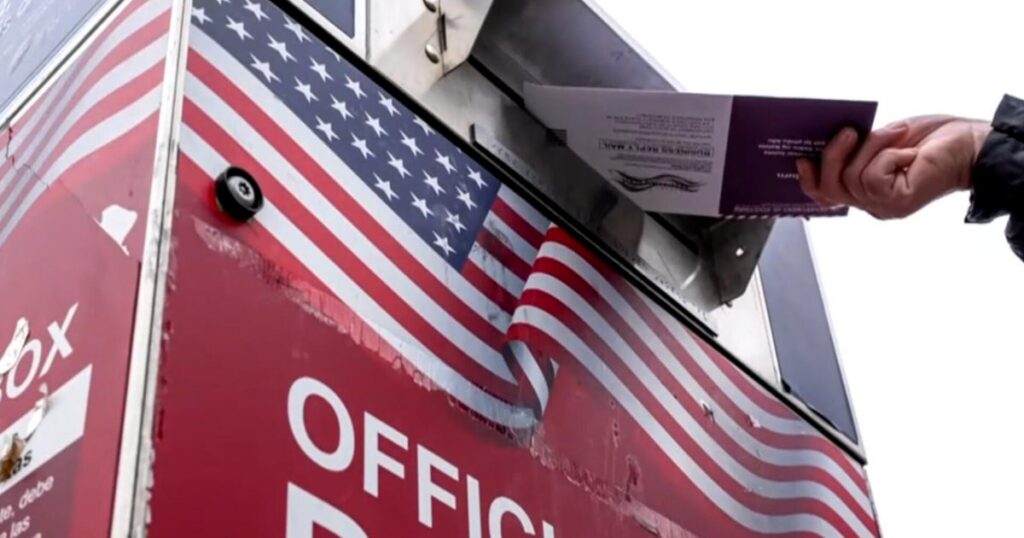
The Department of Justice filed an emergency application Monday asking the U.S. Supreme Court to lift two separate federal court orders blocking the U.S. Postal Service from imposing new restrictions on how states handle mail-in voting — a fast-moving legal showdown that has now produced an unusual result: the administration’s own judicial appointees rejecting its core legal claims.
The request came one day after U.S. District Judge Carl Nichols, a Trump nominee confirmed in 2018, became the second federal judge to block the USPS rule. His order, issued Sunday, went further than an earlier September injunction, barring not only mandatory enforcement but also any voluntary compliance by states. The ruling halted the administration’s plan in its entirety while an appeal moves forward.
“The key portions of the Rule exceed any conception of the outer bounds of these authorities,” Nichols wrote in his 24-page opinion, as reported by The Hill.
What the rule would require
President Trump signed an executive order targeting mail-in voting in March. The USPS rule carrying it out, published late last month, would require states to submit voter lists to a federal portal and ensure their ballot envelopes meet federal design specifications, including unique barcodes. Any ballots from states that don’t comply would not be delivered.
Both courts found the same thing: no evidence of fraud
U.S. District Judge Indira Talwani in Boston issued the first block on September 4, finding the rule likely unconstitutional. She wrote that the record contains “no evidence relating to fraudulent mail voting to support the rushed implementation of the Final Rule” and that implementation less than 70 days before the November election “nearly guarantee[s] significant disenfranchisement for eligible voters.” A unanimous panel of the 1st Circuit Court of Appeals upheld her findings.
Nichols made the same observation. “The Federal Government does not point to any record evidence that there will be significant fraud in the upcoming elections,” he wrote — a notable finding given that the administration’s central justification for the restrictions is preventing noncitizen voting.
DOJ presses on, even acknowledging disenfranchisement risk
Despite those findings, Solicitor General D. John Sauer filed Monday asking the high court to lift both orders, according to Democracy Docket, a voting-rights organization founded by Democratic lawyer Marc Elias. In a supplemental filing, the DOJ argued that blocking “efforts to deter and catch voter fraud” constitutes “a serious irreparable injury regardless of how much voter fraud would actually occur.”
Sauer also pressed for the rule to take effect even though the USPS portal states would need to comply with it still does not exist. The agency had said the tool would be available last week; it never launched, according to Democracy Docket.
Ballots already in the mail
The timing makes the stakes concrete. At least two Wisconsin municipalities and North Carolina had already begun mailing ballots before the rule was blocked. Those envelopes were printed before the USPS requirements existed and cannot be redesigned now. If the Supreme Court lifts both injunctions, USPS would be positioned to refuse delivery of hundreds of thousands of ballots already in circulation, according to Democracy Docket.
The high court could rule at any time.