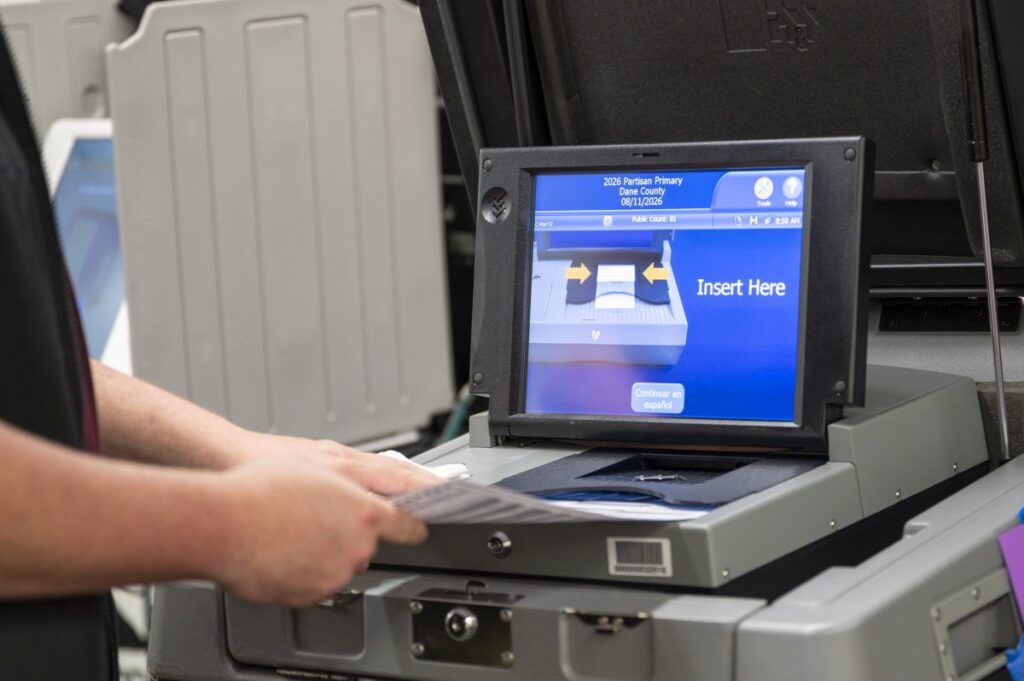
Most of this week’s wins share a quality: they arrived not as surprises but as the result of organized legal work, sustained community investment, or institutions finally exercising authority that had already been established. What changed was not the rules but the willingness to use them.
Wisconsin Judge Rules Voters Can’t Lose Their Ballots Over Official Error
Dane County Judge Everett Mitchell ruled Tuesday that Wisconsin clerks must count ballots held by a municipality by 8 p.m. on Election Day but delayed at polling places by election administrator mistakes, Votebeat reports. The decision resolves a lawsuit by two Madison voters — Margaret and Robert Honig — whose ballots in April’s state Supreme Court race were among 23 delayed by a clerk’s error and initially ordered not counted. “…the failure of election officials to deliver it by 8:00 p.m. is not a lawful ground for rejecting the ballot,” Mitchell wrote. Law Forward, which represented the voters, called it “a major victory for voting rights in Wisconsin.”
Pittsburgh Water Starts Forgiving Debt for 4,300 Low-Income Families
Pittsburgh Water and Sewer Authority launched a 24-month debt forgiveness program in September for customers at or below 200 percent of the federal poverty level — $66,000 a year for a family of four. The 4,300 residents who qualified were automatically enrolled on September 1, and those who pay their current bills on time will have past-due balances forgiven upon completing the two-year program; customers can miss up to two payments and still complete the program. Pittsburgh Water came under state utility commission oversight only in 2018, later than regulated gas and electric utilities that have long operated programs like this one.
Senate Runs Its First-Ever Election Observer Program in Nine States
More than 100 Senate Democratic staff members trained as official congressional election observers will be on the ground in nine states for the November midterms — the first time the Senate has operated such a program, Senators Padilla and Schumer announced Wednesday. Authorized under the 2024 Confirmation of Congressional Observer Access Act, the observers will document voter interference, threats to election workers, and certification disputes on and after Election Day. Senate Republicans have launched parallel observers under the same law, Talking Points Memo reports. The nine states include Georgia, Ohio, Michigan, North Carolina, Maine, Texas, Iowa, Nebraska, and Alaska.
Researchers Credit Community Programs as U.S. Homicide Rate Hits a Century Low
The U.S. homicide rate reached what researchers estimate is its lowest level since at least 1900, following a sharp decline from 2022 through 2026. At a Council on Criminal Justice summit of 48 leading scholars convened in Phoenix last month, expanded community violence intervention programs — which place trained mediators in neighborhoods most affected by gun violence — were among the factors rated as major or limited contributors by more than two-thirds of participants.
Disability Advocates Expand Polling Accessibility Audits to Five New States
Detroit Disability Power, which ran what it calls the nation’s largest poll accessibility audit in Michigan last year, launched a fellowship this year to train five new nonprofits — in Georgia, Indiana, Pennsylvania, Nebraska, and New York — to conduct their own audits, with support from the Carter Center and the American Association of People with Disabilities. DDP itself is expanding from 415 Michigan polling sites in 2025 to roughly 700 this election cycle. More than one in four U.S. adults have a disability; federal law guarantees accessible polling places, but systematic auditing to enforce that guarantee had been rare outside the Detroit area until now.