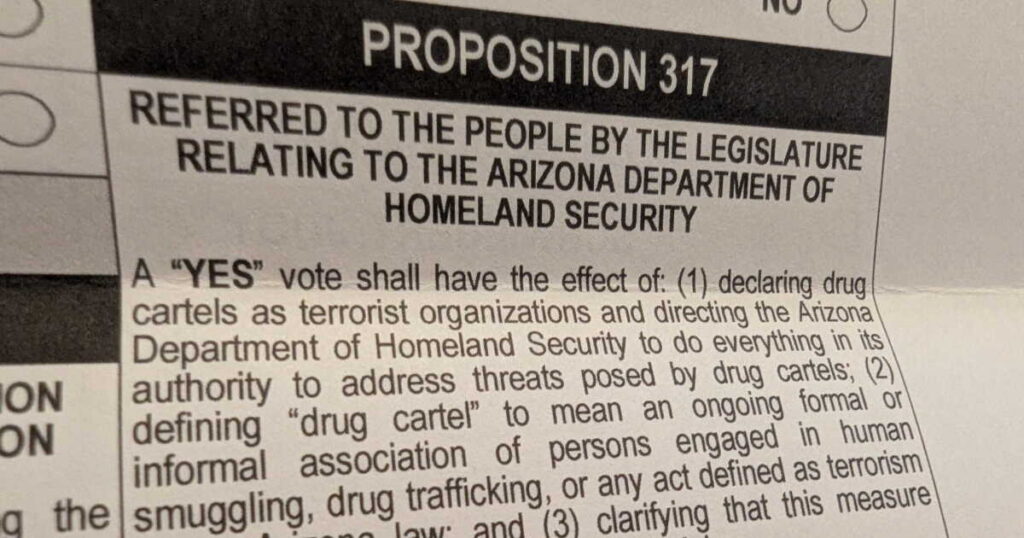
When elected officials reach a stalemate, voters sometimes get the final word. That’s exactly what happened in Arizona, where a contested proposal to designate drug cartels as terrorist organizations — vetoed by the governor, debated in the legislature — was placed directly before the people on Election Day 2026.
Early results from Arizona’s 2026 general election show Proposition 317 leading with more than 54% of the vote, posted roughly an hour after polls closed at 7 p.m. Under Arizona law, a ballot measure needs a simple majority — 50% plus one vote — to become law. That straightforward threshold is part of what makes the ballot measure process one of the most direct expressions of democratic will available to voters.
Voters Step In Where the Legislature Could Not
Prop. 317 is a textbook example of the ballot referral process at work. When legislation gets gridlocked through the normal channels — passed by one party, blocked by another, or vetoed by the executive — legislators can refer the question directly to voters. That’s precisely what Arizona’s Republican-controlled legislature did in 2025, sending this measure to the ballot after Democratic Gov. Katie Hobbs vetoed similar legislation in 2023.
That veto came with a pointed explanation. Hobbs wrote in her veto letter that labeling drug cartels as terrorist groups is “not a real solution and not a state function,” and she noted that the Arizona Department of Homeland Security is an administrative grant management office — not a law enforcement agency — making such a mandate difficult to implement.
Rather than abandoning the effort, Republican lawmakers used the ballot referral mechanism to let voters decide. This process reflects one of the foundational principles of American democracy: when representative government reaches an impasse, citizens retain the power to resolve it themselves. The result of this vote — whatever the final margin — will carry the weight of a direct mandate from Arizona voters, something neither the governor’s veto nor a legislative party-line vote can fully claim.
What the Measure Would Actually Do
If Prop. 317 passes, it would direct the Arizona Department of Homeland Security to do “everything within its authority to address the threat posed by drug cartels.” The measure defines a cartel as an “association of persons in which members or associates individually or collectively engage in” human smuggling, drug trafficking for profit, and any act of terrorism as defined under state law.
Republican lawmakers have argued the measure is necessary to protect Arizona communities from cartel violence and trafficking. Democratic opponents, however, raised concerns that the broad language of the measure could be used in ways that negatively affect immigrants or even victims of cartel activity — people who are themselves endangered, not criminal actors.
A Democratic Mechanism for a Contested Debate
The passage of Prop. 317 through the ballot process — rather than through traditional legislation — matters beyond the policy details. It illustrates how the initiative and referendum system gives Arizona voters a direct democratic voice on issues where the political process has produced division rather than resolution. When voters cast their ballots on a measure like this, they aren’t just making a policy decision; they’re participating in a civic process that holds elected officials accountable and reinforces public trust in the legitimacy of lawmaking.
Arizona voters also weighed in on other ballot measures this election cycle. Early results show voters rejecting Prop. 142, a Republican-backed proposal to ban DEI policies in state government. Results on Prop. 141, a measure that would ban Arizona from pursuing a vehicle mileage tax as an alternative to the gas tax, showed voters narrowly split. And Prop. 319, which would ban photo enforcement systems used to catch traffic violators, was on track to pass in early returns. Full results for all races are available on the Arizona elections page, with updates continuing as vote counts are released. Live updates are also available through the Arizona 2026 general election live updates feed.