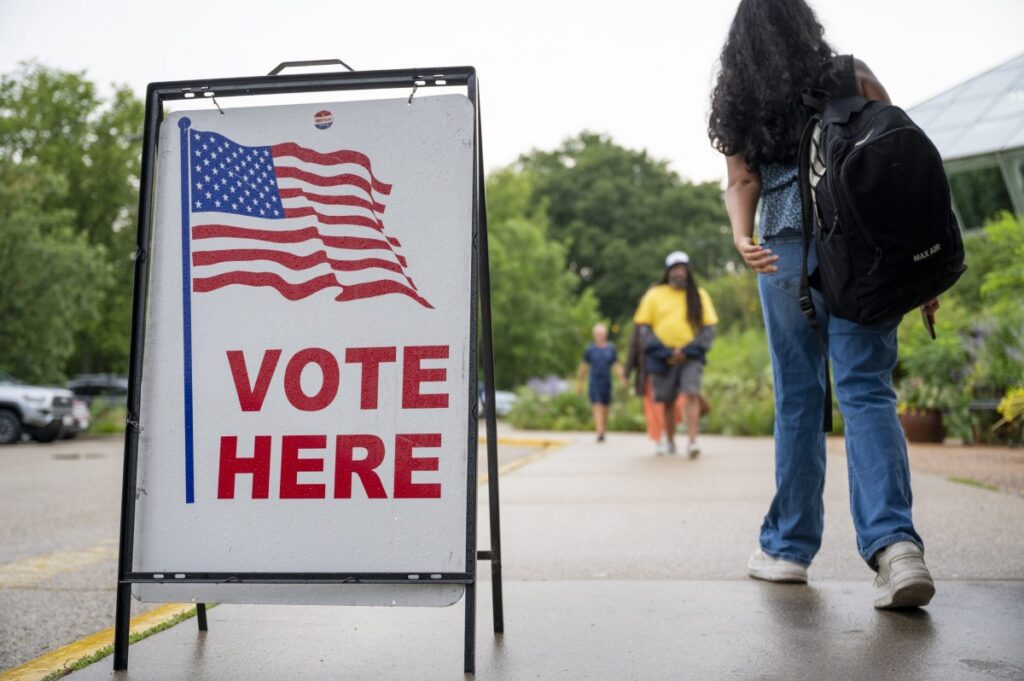
Wisconsin voters head to the polls Tuesday in what could be one of the most consequential Election Days the Badger State has seen in years — a race where control of the governor’s office, Congress, and the state Legislature all hang in the balance. With early voting already surpassing 2022 levels and national political winds shifting, the choices Wisconsinites make today will ripple through state policy for years to come.
Polls are open from 7 a.m. to 8 p.m. Voters must bring a valid photo ID to cast a ballot. Anyone who isn’t yet registered can do so at the polls on Election Day with proof of residency. To find your polling place, check what’s on your ballot, and confirm your registration status, visit myvote.wi.gov. For a deeper look at candidates in statewide, congressional, and legislative races, Wisconsin Watch’s 2026 voter guide is also available.
A Wide-Open Governor’s Race
Wisconsin hasn’t had an open race for governor in 16 years. That changed when Democratic Gov. Tony Evers announced he would not seek a third term, setting off a crowded field that eventually narrowed to two candidates: Democrat David Crowley and Republican Tom Tiffany.
Crowley, 40, currently serves as Milwaukee County executive and previously held two terms in the state Assembly. He narrowly won the Democratic primary in August with an endorsement from Gov. Evers. If elected, he would become Wisconsin’s first Black governor. His platform centers on reducing costs for families — including a public option for BadgerCare and capping child care costs at 7% of household income for families with children under five. He has also pointed to a 2023 bipartisan shared revenue law that gave Milwaukee County and the city of Milwaukee new tools to address pension-related budget shortfalls as evidence of his ability to work across party lines.
Tiffany, 68, has represented Wisconsin’s 7th Congressional District in the U.S. House since 2020 and previously served in both the state Assembly and Senate. He secured the Republican nomination after receiving an endorsement from President Donald Trump. His economic proposals focus on freezing property taxes and cutting income taxes by 10% for families earning under $150,000 annually. Tiffany has also used Crowley’s role in the Milwaukee-area sales tax increase to argue that his opponent would raise taxes as governor.
Each candidate is paired with a lieutenant governor running mate. Crowley’s running mate is Secretary of State Sarah Godlewski. Tiffany’s is David Varnam, a former mayor of Lancaster and stay-at-home dad who defeated the Republican Party of Wisconsin’s endorsed candidate in the primary. On the ballot, governor and lieutenant governor appear as a joint ticket — a vote for one is a vote for both.
What the Polls Show
The final Marquette University Law School poll before Election Day found President Trump’s approval rating among registered voters in Wisconsin at a record low of 37%. Among likely Wisconsin voters, Crowley leads Tiffany 51% to 44%, with 4% undecided. Crowley holds a significant edge with independent voters, leading 56% to 26%.
Early turnout is also notable. As of Friday, more than 693,000 Wisconsinites had already cast a ballot — either in person or by mail — surpassing the 642,000 who voted early at the same point before the 2022 election, according to the Wisconsin Elections Commission.
Congressional Seats in Play
All eight of Wisconsin’s congressional districts are on the ballot Tuesday, but two races are drawing the most attention as Democrats target Republican-held seats.
In the 1st Congressional District, Republican U.S. Rep. Bryan Steil faces Democrat Mitchell Berman, an emergency room nurse running as a political outsider. Berman was added to the Democratic Congressional Campaign Committee’s “Red to Blue” program in September, providing campaign resources and national support. A Fox News Power Ranking listed the seat as a “toss-up,” and the nonpartisan Cook Political Report shifted its rating from “likely Republican” to “lean Republican.”
The 3rd Congressional District may be the most closely watched race in the state. Republican U.S. Rep. Derrick Van Orden faces a rematch against Democrat Rebecca Cooke, a waitress and former political consultant. National Democrats also added this district to the “Red to Blue” program, and Sabato’s Crystal Ball recently labeled the race as “leans Democratic.” Cooke’s priorities include a $15 federal minimum wage, addressing teacher shortages, protecting abortion access, and expanding Medicare. Van Orden, who has held the seat since 2022, has emphasized veterans’ legislation and his alignment with the Trump administration.
Historically, the president’s party tends to lose congressional seats during midterm elections — a pattern that could work against Republicans this cycle.
Control of the Wisconsin Legislature
Republicans have controlled both chambers of the Wisconsin Legislature since 2010, but this year’s map is more competitive than it has been in years. That shift follows significant Democratic gains in 2024 after new legislative maps were signed into law.
In the State Senate, Democrats need to flip two of three Republican-held seats and hold a Democratic district in Eau Claire to claim a majority. In the Assembly, Democrats need to hold all 45 of their current seats and flip five more Republican districts. An analysis by John Johnson, a research fellow at Marquette University Law School, found that former Vice President Kamala Harris carried all four of the key Senate districts in 2024 — and Republicans hold five Assembly seats in districts Harris also won.
Attorney General, Secretary of State, and Treasurer
The race for attorney general is a rematch from 2022. Democratic incumbent Josh Kaul, now in his second term, faces Republican Fond du Lac County District Attorney Eric Toney again — four years after Kaul won their first matchup by less than 2%. Kaul is running on environmental enforcement and the state’s response to the opioid epidemic. Toney has criticized Kaul over backlogs at the state’s crime labs and what he calls the politicization of the Department of Justice through lawsuits against the Trump administration.
Three candidates are competing for Wisconsin secretary of state: Republican Jay Schroeder, Democrat JoCasta Zamarripa, and Green Party candidate Pete Karas. Schroeder has proposed dismantling the Wisconsin Elections Commission and transferring its duties to the secretary of state’s office — a move that would require approval from both the governor and the Legislature. Zamarripa has said she sees the position as a platform for protecting voting rights. Karas said his campaign aims to challenge the state’s two-party system.
In the treasurer’s race, Republican incumbent John Leiber faces Democrat Yee Leng Xiong, the executive director of Wausau’s New Beginnings for Refugees and a member of both the Marathon County Board and D.C. Everest School Board. The office currently holds limited responsibilities — Republicans even tried to eliminate it entirely eight years ago, but voters rejected that effort. Leiber is running on continuity; Xiong sees an opportunity to expand the role, particularly if Democrats gain control of the Legislature and governor’s office.
Three Constitutional Amendments
Voters across Wisconsin will also weigh in on three proposed changes to the state constitution. Republican lawmakers, unable to override Gov. Evers’ vetoes, have used the constitutional amendment process to bypass the governor’s pen during his eight years in office.
The first amendment would limit the governor’s ability to use a partial veto to raise taxes or fees. It stems from Evers’ 2023 veto extending school district revenue limits for 400 years — which Republicans have characterized as a property tax increase, though it’s worth noting that the decision to actually raise property taxes rests with local school boards, not the state.
The second amendment would prohibit state government from closing places of worship during a public health emergency, such as the COVID-19 pandemic.
The third amendment would bar government entities — from school districts to state agencies — from discriminating against or giving preferential treatment to individuals based on race, sex, color, ethnicity, or national origin. Both supporters and opponents of the measure have described it as an anti-diversity, equity, and inclusion measure that could restrict programs serving minority communities.
School Funding Referendums and Local Races
Seventy-one school districts are asking local voters to approve tax increases to cover operating costs or fund construction projects. Fifty-four districts seek operational funding support, 10 are requesting capital project approval, and seven — including Brown Deer, Greenfield, Little Chute, Lodi, Princeton, Unity, and Waunakee — are asking voters to approve both. Earlier this year, 72 school districts brought similar questions to voters in April, and just over 60% were approved.
Local elections for county sheriff and clerk of circuit court are also on ballots across the state. To see exactly what’s on your ballot, visit myvote.wi.gov. For original reporting on Wisconsin elections and government, Wisconsin Watch is a nonprofit, nonpartisan newsroom — you can subscribe to their newsletters for ongoing coverage.