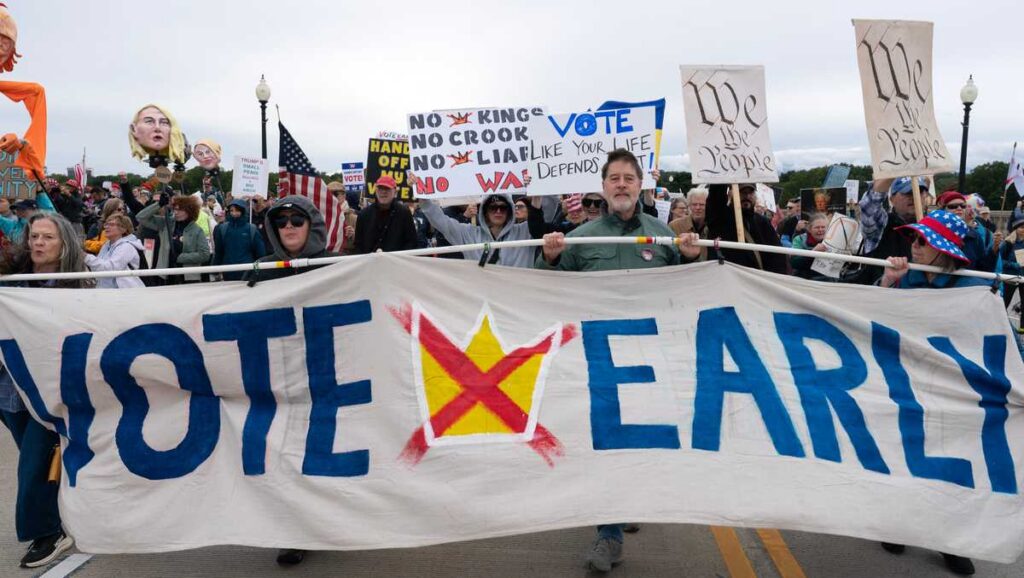
With midterm elections just weeks away, Americans in cities from coast to coast took to the streets Saturday to make one message clear: vote early. The gatherings, organized under the No Kings banner, reflected a broader national conversation about voter access, election participation, and the future of American democracy.
Hundreds of planned events took place across the country, billed as nonpartisan get-out-the-vote efforts. They built on nearly two years of No Kings marches and demonstrations by Americans concerned about the direction of President Donald Trump’s presidency. At the Lincoln Memorial in Washington, D.C., a band played for a crowd of several hundred bundled-up attendees who danced despite the cold, waving signs that read “VOTE EARLY” and “HANDS OFF MY VOTE!”
A Call to Use the Vote as a Tool of Democracy
In Atlanta, City Councilman Michael Julian Bond addressed the crowd with a direct challenge about civic power and the November 3 general election.
“The Constitution gives you one power, right? That is the power to vote. Are you gonna use that power?”
he asked.
Bond pressed the point further with a vivid comparison most Americans could appreciate:
“You don’t see Superman giving up his power. You don’t see Black Panther giving up his power. You don’t see Wonder Woman giving up her magic lasso. So why would you give up your right, your power, your obligation to vote? Be a superhero, use your power. Go to the polls and vote.”
Bond’s message captures a fundamental principle that election experts and civic organizations consistently emphasize: voter participation is one of the most direct ways eligible citizens can shape their government. Early voting, where available, reduces the risk that unexpected circumstances on Election Day keep people from casting their ballots.
A Legal Battle Over Mail-In Ballots in California
The rallies unfolded against a backdrop of significant legal and political tension surrounding mail-in voting ahead of the midterms. President Trump has long been skeptical of mail voting, and has claimed without evidence that voting fraud cost him the 2020 presidential election. That claim has been investigated and rejected by election officials, courts, and independent investigators across the country.
On Thursday, the Trump administration sued California election officials, asking a federal judge to block the state from counting mail-in ballots from voters the federal government has identified as “likely” noncitizens — unless their immigration status can be first confirmed. It is worth noting that noncitizens are already prohibited from voting in federal elections, and election officials routinely have processes in place to verify voter eligibility.
Then on Friday, the Justice Department issued a warning to local election officials, stating that those who process and count ballots submitted by suspected noncitizen voters could face criminal investigation and potential prosecution. That warning raised immediate concerns among election administrators about how it might affect the normal, lawful processing of ballots.
Senate Democrats Push Back on DOJ
Also on Friday, three Democratic U.S. senators responded directly. Sens. Alex Padilla of California, Sheldon Whitehouse of Rhode Island, and Dick Durbin of Illinois sent a letter to Attorney General Todd Blanche demanding a commitment from the Justice Department that it would not seize ballots or other election materials before the midterm election results are certified. Their concern: that federal intervention in ballot processing could disrupt a system that election officials across the country — both Republican and Democrat — work to administer carefully and according to established law.
Taken together, these developments reflect a moment of heightened tension around election administration in America. For everyday voters, the stakes are straightforward — whether their ballot, cast legally and in good faith, will be processed and counted. Election security experts broadly agree that existing safeguards are designed to catch ineligible votes without disenfranchising eligible citizens, and that undermining confidence in those safeguards without clear evidence of widespread fraud risks eroding public trust in democratic institutions.
For those organizing and attending Saturday’s rallies, the answer to that uncertainty was simple: show up early, cast your ballot, and exercise the one power the Constitution guarantees every eligible American citizen. Reporting on this story is available through established editorial standards for sourcing and accuracy. Readers who want to stay informed can sign up for email alerts or follow election coverage through a variety of local news outlets.