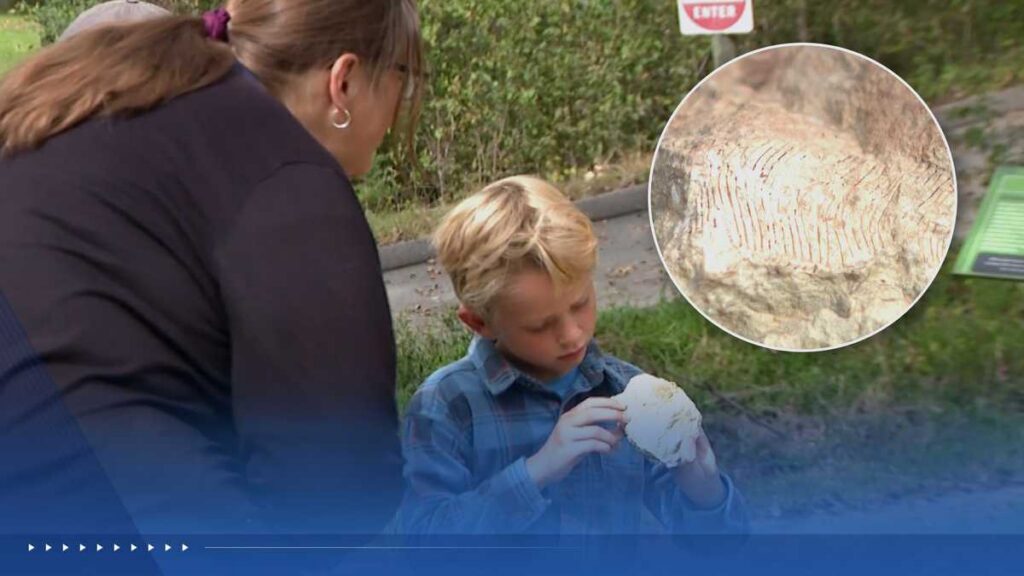
A young boy’s summer outing to a Nebraska state park turned into a moment that geologists and historians are still talking about — because what Leo Youngdahl pulled from the ground hadn’t been seen in the state for more than half a century. The 6-year-old’s sharp eyes and rock-hunting instincts led to a discovery that is now reshaping what educators at Schramm Park State Recreation Area teach visiting children about Nebraska’s ancient past.
Leo, who has been collecting rocks since he was a toddler, has always had a knack for spotting what others might walk right past.
“When I was a baby, we would go out in nature, and I would be picking up rocks and putting them in the bucket,”
he said. Over time, he learned to tell different specimens apart —
“Agates and gemstones and fossils,”
he explained. Before this summer, he had already found brachiopods and various shell fossils. But nothing like this.
Standing near the spot where he made his find at the park — located about 28 miles outside of Omaha — Leo described his first impression of the object: he thought it looked like
“an upside-down snake shed.”
It turned out to be something far more significant.
A Find That Stumped the Experts — At First
Kelly Ekue, an educator at Schramm Park, immediately knew something was unusual when Leo showed her what he had found. The park typically yields a predictable set of fossil types, so an unfamiliar specimen raised eyebrows right away.
“Normally, we see six different kinds of fossils here,”
Ekue said.
“I looked at it, and I was like, okay, that’s really weird. It looks like a fish. And so we don’t have any vertebrates here in our fossil outcrops.”
Local geologists were brought in to examine the specimen. Their conclusion: Leo had found a conulariid — a type of ancient jellyfish that inhabited what is now Nebraska between 200 million and 500 million years ago, during a time when much of the state lay beneath a vast inland sea. Because conulariids had soft bodies, their remains rarely survived long enough to fossilize, making confirmed specimens exceptionally uncommon.
“Certainly for Nebraska history, it’s important that we’ve found one. And the last ones that we found on record were from the 1970s,”
Ekue said.
That makes Leo’s discovery the first documented conulariid found in Nebraska in more than 55 years — a remarkable milestone for a first-grader who simply set out to look for interesting rocks.
What Happens Next
The fossil is now in the care of Schramm Park, where staff are using it as an educational tool for visiting children — turning one boy’s discovery into a learning opportunity for many. Leo, for his part, hasn’t slowed down.
“Fossils are cool. And I would like to find out all about the things that lived before, because I kind of don’t know what all of them are called,”
he said.
For anyone inspired to try fossil hunting of their own, Leo offered a practical tip drawn from hands-on experience:
“I look out for rocks that have kind of lots of nooks and crannies because I think they have more fossils.”
It’s advice worth heeding — after all, it came from the kid who just made Nebraska history. For more stories like this one, subscribe to the News We Love newsletter to get uplifting and informative stories delivered directly to your inbox.