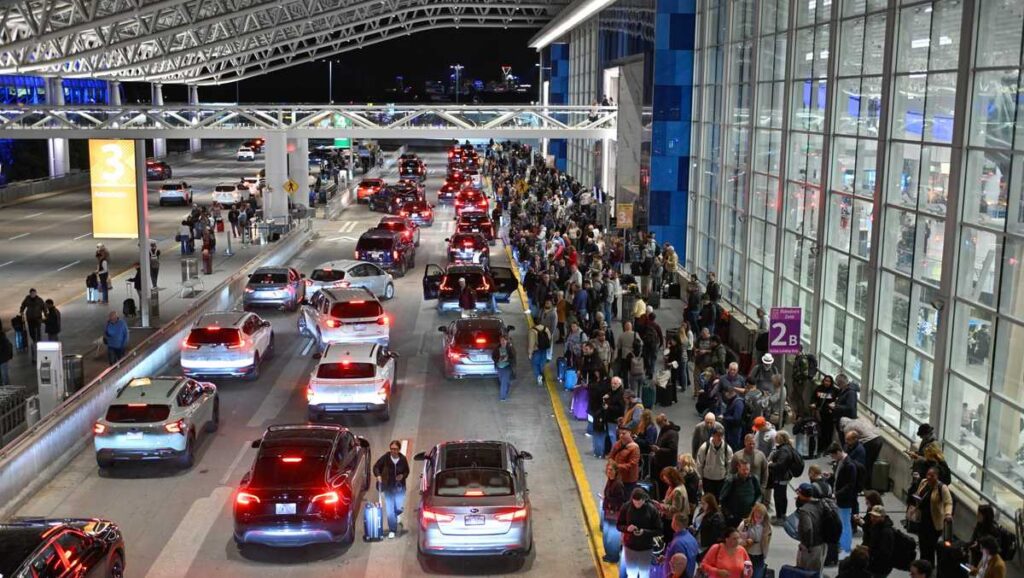
For five hours on Friday, the skies above America were essentially frozen — no takeoffs, thousands of diversions, and more than 1.5 million travelers left waiting for answers. It marked the longest nationwide ground stop in 25 years, and the cause, officials say, came from within the system itself.
The Federal Aviation Administration halted most departures across the United States after new technology being integrated into the aging air traffic control network caused communication and radar failures. The ground stop was lifted Friday evening, but the ripple effects were immediate and widespread: more than 3,000 flights were affected, at least 827 were diverted, and airlines warned it could take days to fully recover as planes and crews ended up out of position across the country. Despite the disruption, officials said no one was in danger.
Secretary of Transportation Sean Duffy acknowledged the severity but could not rule out a repeat. Secretary of Homeland Security Markwayne Mullin explained at the White House that the FAA had been installing
“new equipment, new technology”
that was
“overwhelming the older system.”
Mullin added there was no sign of a cyberattack, saying there are no
“footprints”
suggesting an outside attack and that the event appears to be
“mechanically driven.”
When pressed on whether he could fully rule out a cyberattack or rogue artificial intelligence involvement, Mullin said:
“There’s nothing completely certain right now. It doesn’t appear that way.”
At its peak, 3,500 aircraft were in the air when the ground stop began. Duffy noted that at one point fewer than 400 remained in the airspace.
“And last time I looked, we had less than 400 in the airspace,”
he said, adding that a return to normal air traffic levels would be gradual.
By 7:05 p.m. EST, aviation analytics firm Cirium reported that 670 flights had been sent back to their departure airports, while another 157 were redirected elsewhere. Major diversion points included Washington Dulles, Los Angeles International, Cincinnati/Northern Kentucky International, and Nashville International airports.
Travelers Left Scrambling
At Chicago O’Hare, passengers discovered the mass delays only after glancing at airport screens already filled with red. Some called family. Others debated whether to stay the night or find ground transportation.
Amber McQuilkin, 27, a software engineer from Seattle, had taken a full week of vacation to attend the League of Legends world finals in New York with friends who had already arrived. She sat on a bench at O’Hare unsure what to do.
“There’s not really any information being passed to me,”
she said.
“I contemplated just abandoning the flight and driving, but then the more I thought about it, the more I’m like, that would be miserable.”
Austin Curtis and his wife had boarded a flight from O’Hare bound for a friend’s baby shower in Denver when they were asked to deplane.
“We did see them taking luggage off our plane and others, so we’re assuming it’s going to be a pretty substantial delay,”
Curtis said. The couple, with childcare already arranged at home in South Bend, Indiana, considered staying the weekend in Chicago.
Sports, Cargo, and Other Disruptions
The ground stop extended well beyond passenger inconvenience. NBA, NHL, and college athletic teams were stranded mid-travel, while NFL teams faced uncertainty about weekend game logistics. Nationwide flight grounding disrupted football games this weekend, prompting Duffy to say NCAA teams would be prioritized.
“I would encourage those football teams to reach out to the FAA, to schedule their flight times and make sure they can move”
in time to make kickoff, he said.
Cargo operations were also hit. FedEx, the world’s largest cargo airline, said it was prepared to activate contingency plans to minimize disruptions. The airline industry moves roughly 61,000 tons of goods daily to more than 220 countries, according to Airlines for America. Despite the chaos, SpaceX successfully launched its Starship rocket from Texas Friday afternoon during its latest test flight.
A radio traffic recording captured a student pilot seeking help from air traffic control during the ground stop, illustrating just how disorienting the communications breakdown was for those in the air.
What Made This Different
Aviation safety expert Steve Arroyo, a former United Airlines pilot, said this event stood apart from past incidents because of its national scope. While a September outage disrupted hundreds of flights across the Northeast — caused by a construction crew severing a fiber optic line — Friday’s failures cut across the entire country. Aging infrastructure has also been blamed for brief radar outages at Newark airport in recent years.
“If you don’t have that ability, whether it’s because the old wires that they have are just run down or for whatever reason, you’ve got to stop airplanes on the ground and not put them in the air, where you’re going to risk not being able to communicate with them,”
Arroyo said.
He also noted that Friday’s situation differed from the post-9/11 ground stop, in that planes were not ordered to land immediately and pilots were still able to communicate with ground controllers at airports.
No Connection to Microsoft Outage or Weather Radars
Friday’s disruption arrived one day after a major Microsoft outage left thousands — possibly millions — unable to access Outlook. With two significant tech failures occurring within 24 hours, speculation spread quickly about a possible link. Both Microsoft and federal officials denied any connection. Microsoft stated on social media:
“We have no indication that the FAA’s nationwide ground stop is related to any Microsoft services.”
Mullin called them
“separate issues,”
saying he didn’t see
“any reason to connect those two at all.”
Separately, the National Weather Service confirmed that weather radars were fully operational, pushing back against a viral rumor suggesting otherwise.
“In case you heard otherwise, there is no radar outage and https://radar.weather.gov is fully operational!”
the NWS posted, adding that outdated content from isolated webpages was circulating but that
“NWS radars are operating normally.”
Officials say they expect the air traffic system to be fully recovered ahead of the Thanksgiving travel rush, though the investigation into exactly what went wrong — and how to prevent it — is ongoing. This article meets the Editorial Standards of Hearst Television.