For over a century, toxic chemicals dumped into Milwaukee’s rivers have quietly worked their way into the food chain — contaminating insects, fish, and the people who eat them. Now, a newly completed facility is offering a long-term solution to one of the region’s most stubborn environmental problems.
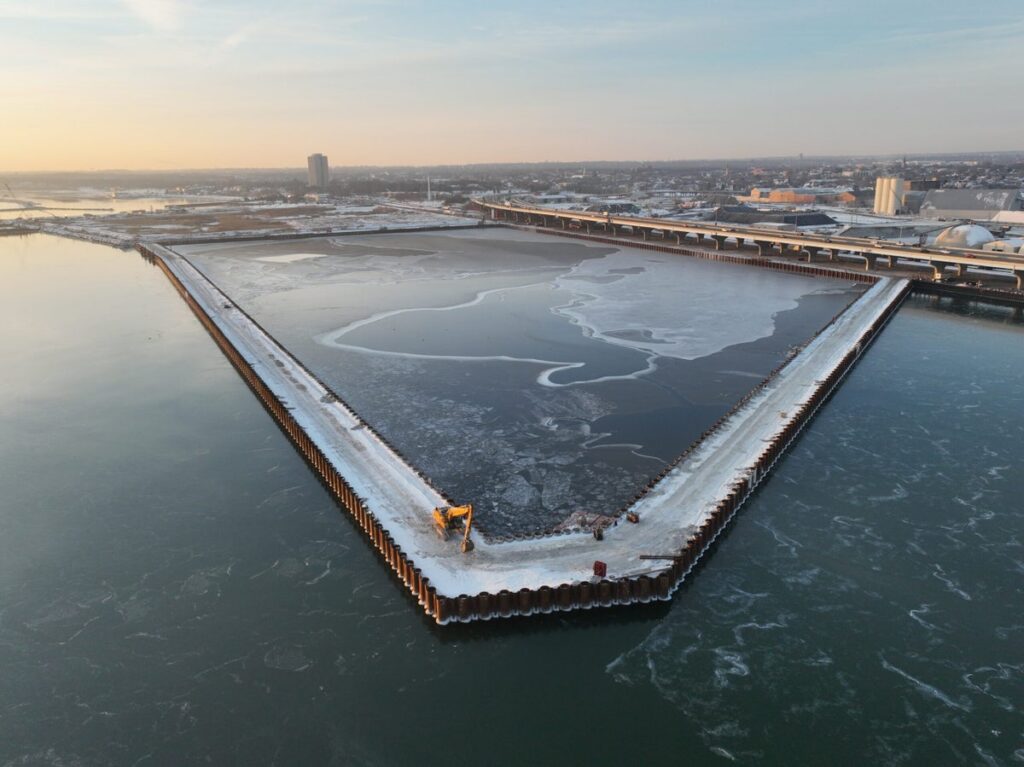
A 42-acre containment site along the shore of Lake Michigan officially opened this fall, designed to hold up to 1.9 million cubic yards of contaminated sediment pulled from the riverbeds of southeast Wisconsin. The $123 million project — known as the Dredged Material Management Facility, or DMMF — came in under budget and is expected to fill over the next 20 to 30 years as dredging operations get underway.
To understand the scale: 1.9 million cubic yards is roughly equivalent to 13 football fields stacked 50 feet deep. The facility was completed in October and is managed by the Milwaukee Metropolitan Sewerage District.
Decades of Pollution Buried in the Riverbed
More than 100 years before modern pollution control laws existed, industrial companies discharged waste directly into Wisconsin’s waterways. That legacy left behind layers of sediment containing cancer-causing toxins like PCBs (polychlorinated biphenyls), PAHs (polycyclic aromatic hydrocarbons), and heavy metals — all of which continue to affect the ecosystem today.
Cheryl Nenn, the riverkeeper for the Milwaukee Riverkeeper nonprofit, explained the problem in a recent interview on WPR’s “Wisconsin Today.”
“That contaminated sediment is causing a lot of impacts to the very bottom of the food chain, the insects at the bottom of the river. It’s getting into the fish, it’s getting into people eating the fish,”
she said.
The toxic sediment targeted for removal comes from three rivers — the Milwaukee, Menomonee, and Kinnickinnic — all of which converge before flowing into Lake Michigan. That junction is known as the Milwaukee Estuary, which was designated one of 31 Areas of Concern along the Great Lakes by the U.S. and Canada in 1987. That federal designation made the DMMF project eligible for government funding.
How It Works — and How It’s Kept Safe
Dredging vessels will essentially vacuum contaminated material from deep within the riverbeds, with that sediment then transported to the facility. Once inside, it stays — permanently. But many people want to know how officials plan to prevent those toxins from seeping into Lake Michigan, the region’s primary drinking water source.
Bridget Henk, the principal project manager at the Milwaukee Metropolitan Sewerage District and leader of the DMMF project, acknowledged that concern directly.
“That is the biggest question we get from a lot of different folks,”
she said.
The design centers on containment. A 2.5-to-3-foot-thick wall runs around the entire perimeter of the facility. Known as a soil mix cutoff wall, it functions as an impermeable barrier. Monitoring systems continuously track water levels both inside and outside the facility — if those levels ever equalize, it signals a potential leak and triggers an alert for officials to respond.
While other dredged material facilities exist across Wisconsin and the broader United States — including one located directly adjacent to the new DMMF — what sets this project apart is the nature of the material being stored. Most comparable sites hold non-toxic sediment removed to keep shipping channels navigable. This facility is specifically engineered for hazardous waste.
Nenn described the broader significance of the project for the region’s waterways.
“We really do think this is a generational opportunity to clean up a lot of this legacy contamination,”
she said.
“It is really getting us closer to our ultimate goals, which are clean rivers that can be used for things like swimming and fishing and drinking.”
Once the facility reaches capacity over the coming decades, the sediment will remain on-site permanently. Officials have noted the possibility of capping the site and constructing something on top of it in the future — though those decisions will ultimately rest with the City and Port of Milwaukee, which will take over ownership of the facility.
For more on related environmental coverage, see recent reporting on how the EPA proposes shifting oversight of coal ash landfills in Wisconsin to state regulators, how a Milwaukee County judge reversed a trespassing citation in a Lake Michigan beach walker case, how Wisconsin and groups are suing the Trump EPA for rollback of mercury standards, and efforts by a local nonprofit tackling causes and solutions to sediment buildup threatening Lake Pepin. Additional coverage of Wisconsin environment, news, and waters stories is available through WPR reporting.