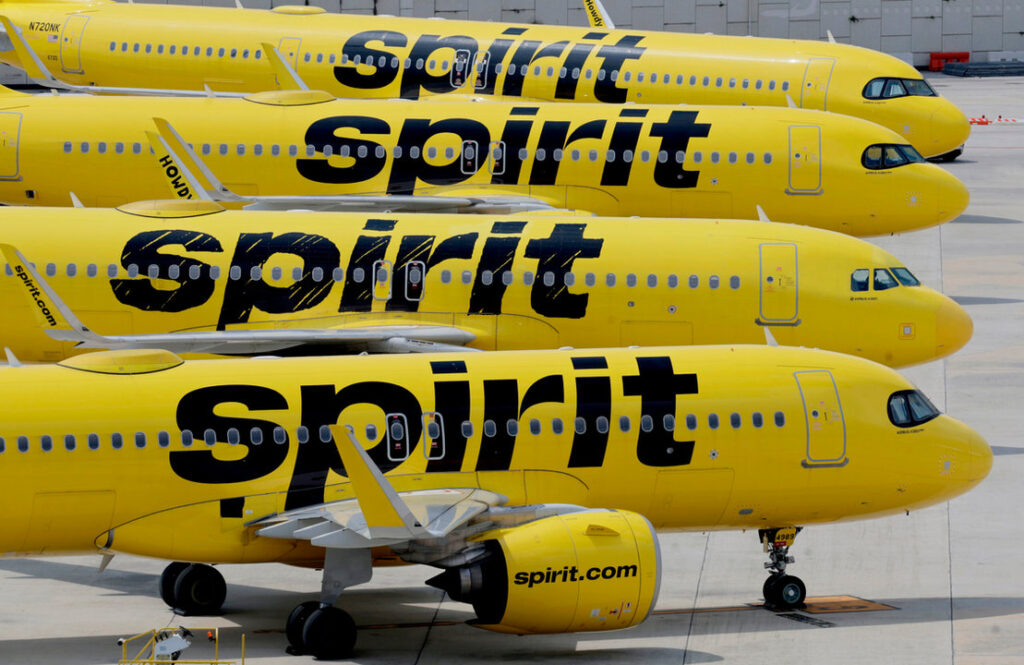
Spirit Airlines Halts Operations After 34 Years
Spirit Airlines, once a staple for affordable travel, has ceased all flights and customer support as it initiates an “orderly wind-down” of its business. The abrupt move puts about 17,000 positions at risk and strands passengers who counted on Spirit’s low-cost model.
The airline confirmed this week that every flight has been canceled effective immediately, and no customer service channels remain open. Spirit’s chief financial officer, Fred Cromer, testified that the carrier faced nearly $100 million in extra fuel expenses from March through April 30, driven by soaring jet fuel prices tied to President Trump’s actions against Iran and disruptions in the Strait of Hormuz.
The Trump administration had discussed a roughly $500 million rescue for Spirit, with the president stating on Friday that officials had delivered a “final proposal” for a taxpayer-backed takeover. However, opposition from key creditors and some Republicans caused the plan to collapse. Cromer said in court filings that the funding “was no longer an available option.”
Tad DeHaven, a policy analyst at the Cato Institute, argued that multiple decisions under the Trump administration compounded Spirit’s troubles. He called the decision to strike Iran “bad foreign policy,” adding, “They were already in trouble,” and describing the situation as “a compounding effect in terms of policy.”
Final Flights and Stranded Travelers
Spirit deliberately grounded its last planes by 3 a.m. Saturday to ensure no aircraft remained mid-route and to give crew members time to arrange lodging. The carrier’s final flight touched down in Dallas Fort Worth International Airport after departing Detroit Metropolitan Airport.
Many customers only learned of the shutdown upon arriving at the airport. At Atlanta’s Hartsfield–Jackson, departure boards still showed five Spirit flights as “on time” Saturday morning. Taylor Nantang, who drove from Tennessee with her husband and four children for a Miami getaway, said, “What!?” and then asked, “So the whole airline at every airport is out of business? Oh my, that’s crazy.”
Joshua Sigler, who bought a ticket the previous day, reported receiving no notice from the airline. Reflecting on Spirit’s appeal, he remarked, “They get you there. It was cheap.”
Employee Reactions and Refunds
Spirit staff were equally taken aback. Former flight attendant Freddy Peterson returned on a Delta Air Lines flight from Newark to Atlanta after landing late Friday night in Newark. Peterson said the service had been “normal” before he checked the Spirit website at 3 a.m. and saw the cancellation notice. “I’ll probably do the boo-hoo crying and all that other stuff once I get in my car,” he admitted. He also noted that Spirit had “done wonders” for him personally.
Secretary Duffy stated that Spirit maintained a reserve to refund customers who booked directly, but those who purchased through travel agents or other third parties must seek reimbursement from their vendors. United, Delta, JetBlue, and Southwest are offering one-way fares of $200 for travelers with Spirit confirmation numbers and proof of purchase, while several airlines have pledged preferential hiring for displaced Spirit employees.
Impact on Markets and Industry
Analysts warn that Spirit’s exit will hit budget travelers hardest in markets where the airline was dominant, such as Las Vegas, Fort Lauderdale, and Orlando. Labor unions representing pilots, flight attendants, and ground staff cautioned that reduced competition may push fares higher.
Data from aviation analytics firm Cirium show that Spirit carried about 1.7 million domestic passengers in February—roughly 500,000 fewer than in the same month a year earlier. Likewise, available seat capacity in May was nearly half of what it had been in May 2024.
Asset Sales and Remaining Staff
As part of its wind-down plan, Spirit seeks court approval to auction aircraft, spare engines, and other equipment. Initially, the company will keep around 150 employees to manage the process, scaling down to about 40 after a few months. These retained roles are expected to cost at least $10.7 million.
Spirit released a final statement: “We are proud of the impact of our ultra-low-cost model on the industry over the last 34 years and had hoped to serve our guests for many years to come.”