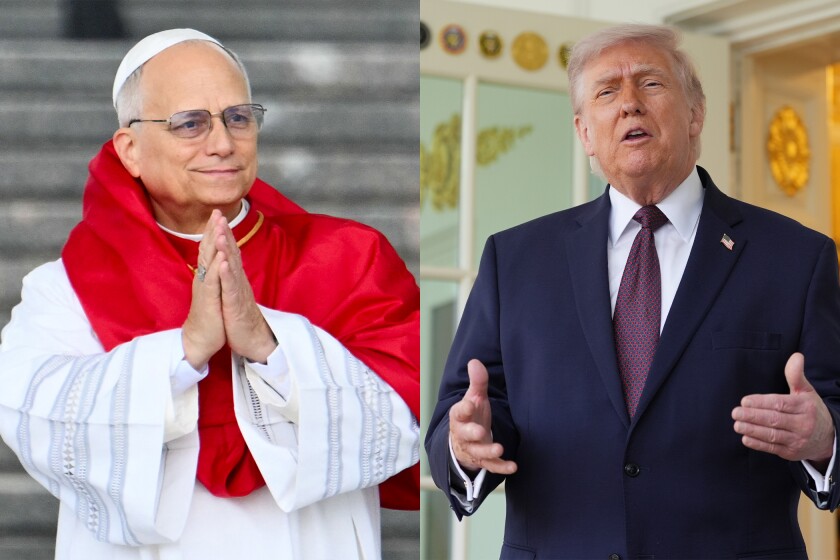
Two of the most prominent global figures, Pope Leo XIV and former President Donald Trump, have launched into an unusual public debate over the war in Iran. Their rapid-fire statements shed light on sharply contrasting views of conflict, leadership and the influence of faith in public discourse.
From online posts to speeches abroad, this rare exchange underscores tensions between religious authority and political power.
Public Exchange over Iran Conflict
On social media, Trump labelled the pope “Weak” and captive to the “Radical Left,” even suggesting Leo owed his position to Trump himself. The pontiff responded en route to Africa, calling such threats “truly unacceptable” and emphasizing church teaching over partisan debates.
“I’m not afraid of the Trump administration,” Leo declared on Monday, “or of speaking out loudly about the message of the Gospel, which is what the Church works for.”
This exchange features two Americans wielding global platforms in a way not seen before.
Leo XIV’s Early Papal Actions and Past Positions
Before his election, Robert Prevost had already voiced strong views on world affairs. As a Peruvian bishop in 2022, he called Moscow’s actions in Ukraine an “imperialist invasion,” a comment later highlighted by Italian media after he became pope on May 8, 2025.
In early 2025, then-Cardinal Prevost used social media to share a news analyses critiquing U.S. Vice President JD Vance’s immigration stance under the headline “JD Vance is wrong: Jesus doesn’t ask us to rank our love for others.”
On May 8, 2025, Trump posted on Truth Social: “Congratulations to Cardinal Robert Francis Prevost, who was just named Pope. It is such an honor to realize that he is the first American Pope. What excitement, and what a Great Honor for our Country. I look forward to meeting Pope Leo XIV. It will be a very meaningful moment!” He later told reporters at the White House that he was “a little bit surprised and very happy” by the result.
Within days, Trump asserted, “He wasn’t on any list to be Pope, and was only put there by the Church because he was an American, and they thought that would be the best way to deal with President Donald J. Trump.”
From St. Peter’s balcony, Leo XIV offered his first words: “Peace with you all … the first greeting of the risen Christ, the Good Shepherd who gave his life for the flock of God.” For his first Sunday blessing, he decried the Russian war in Ukraine and violence in Gaza as signs of a “third world war in pieces.” Quoting Scripture the following Monday, he reminded journalists: “In the Sermon on the Mount, Jesus proclaimed: ‘Blessed are the peacemakers.’”
By speaking primarily in Italian and Spanish rather than English, Leo signaled his commitment to a universal papacy, distancing himself from U.S.-centric expectations.
Trump’s Perspective and Ongoing Dispute
During Holy Week, their rift deepened. On Palm Sunday, Leo XIV called Jesus the “King of Peace,” warning God “does not listen to the prayers of those who wage war, but rejects them, saying: ‘Even though you make many prayers, I will not listen: your hands are full of blood.’” Meanwhile, Trump convened conservative religious leaders at the White House, and on Easter threatened widespread bombing of Iran’s infrastructure and the “eradication” of a “whole civilization,” prompting the pope to label such rhetoric “truly unacceptable.”
Trump later renewed his criticism, calling Leo “weak” and tied to the “Radical Left,” and argued, “I don’t want a Pope who criticizes the President of the United States because I’m doing exactly what I was elected, IN A LANDSLIDE, to do.” (His 2024 win was by no means a landslide.) He urged the pontiff to “focus on being a Great Pope, not a Politician.”
On the flight to Algeria, Leo told The Associated Press, “To put my message on the same plane as what the president has attempted to do here, I think is not understanding what the message of the Gospel is. And I’m sorry to hear that but I will continue on what I believe is the mission of the church in the world today.”
This unfolding exchange highlights a pope determined to keep his spiritual mission above political clashes, while a former president treats him as a rival in global influence.