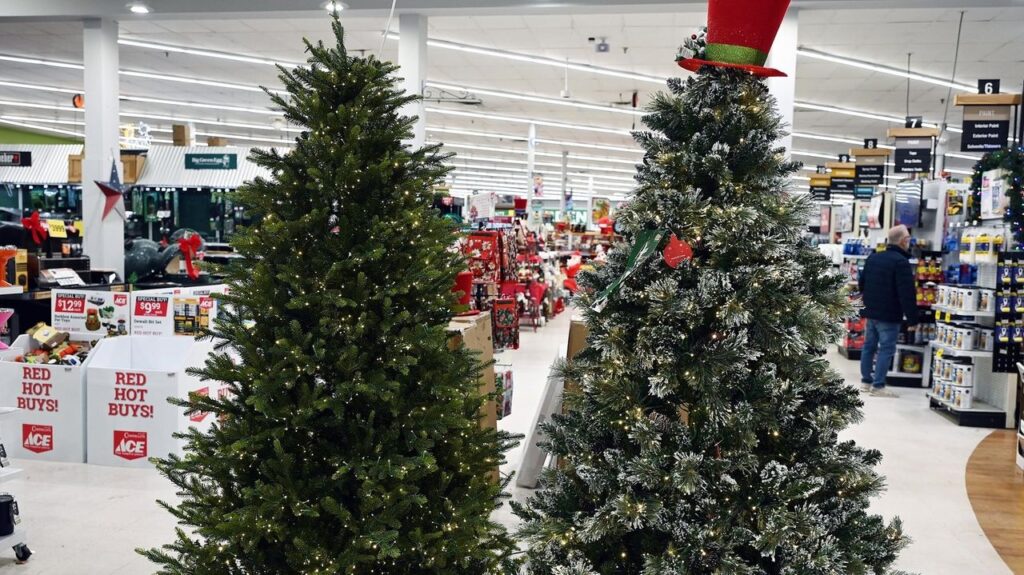
Shoppers hunting for artificial Christmas trees this season may find shelves surprisingly bare, as import tariffs have reshaped holiday inventory decisions. With higher costs squeezing margins, some retailers skipped ordering trees altogether, while consumers increasingly turn back to real evergreens.
Tariffs Pressure Prices and Selection
This year’s 30% tariff on artificial Christmas trees imported from China—responsible for 87% of U.S. supply—has driven retail costs up by 10% to 15%, according to Jami Warner, executive director of the American Christmas Tree Association. She notes the price range now runs from about $60 to $100 for a small basic tree, $150 to $250 for a 6½- to 7-foot model, and $250 to $500 for premium pre-lit versions.
“They had to pass some of the costs on [to consumers],” Warner explained. “Otherwise, they would have completely gone out of business.” She added that while overall inventory is slightly lower because retailers are wary of the “tariff roller coaster,” there isn’t a shortage of trees.
Retailers Scale Back Holiday Stock
At Trio Hardware in Plainview, co-owner Todd Kirschner opted not to order any artificial trees this year, fearing that tariff-driven price hikes would deter shoppers. Instead, the 62-year-old store has sold out of real tree stands for the first time, he said. “I can’t tell you the last time I ever sold out of a tree stand.”
Farmingdale-based Costello’s Ace Hardware also felt the sting of unpredictable tariffs. “When a buyer commits to orders, they are required to predict what the tariff rate will actually be months into the future. The unpredictability of exactly how much tariffs would impact cost created uncertainty,” said CEO Michael Costello.
To keep prices manageable, Costello’s reduced its holiday assortment and drew from U.S. warehouse stock. “The result this year is a smaller overall assortment, fewer new and innovative choices, and less inventory depth. This was the trade-off for keeping retail prices in check,” he said, noting a surge in sales of real tree stands.

Merrick resident Georgia Nagy, in Costello’s Ace Hardware’s Bellmore store Saturday, said her artificial Christmas tree at home is about 10 years old and she may buy a real one this year. Credit: Joseph Sperber
Consumers Reevaluate Decor Choices
Massapequa resident Julie Liebow, 63, decided against replacing her worn artificial tree at current prices. “I feel like I’m at the point now where I’d probably rather wait to the end of the season and buy one on sale than pay for a new one right now,” she said.
Merrick’s Georgia Nagy, 71, said sky-high artificial tree prices have her leaning toward a real tree for upcoming family visits. “I had seen artificial trees and I had seen the prices. It’s outrageous,” she said, adding she prefers real trees for their look and feel rather than cost.
Real Tree Growth and Pricing
Most real Christmas trees sold in the U.S. are domestically grown, with Oregon leading production, according to Marsha Gray, executive director of the Real Christmas Tree Board. A September survey of 43 wholesale growers—representing at least half the U.S. market—found that 84% do not plan to raise wholesale prices this season, Gray said.