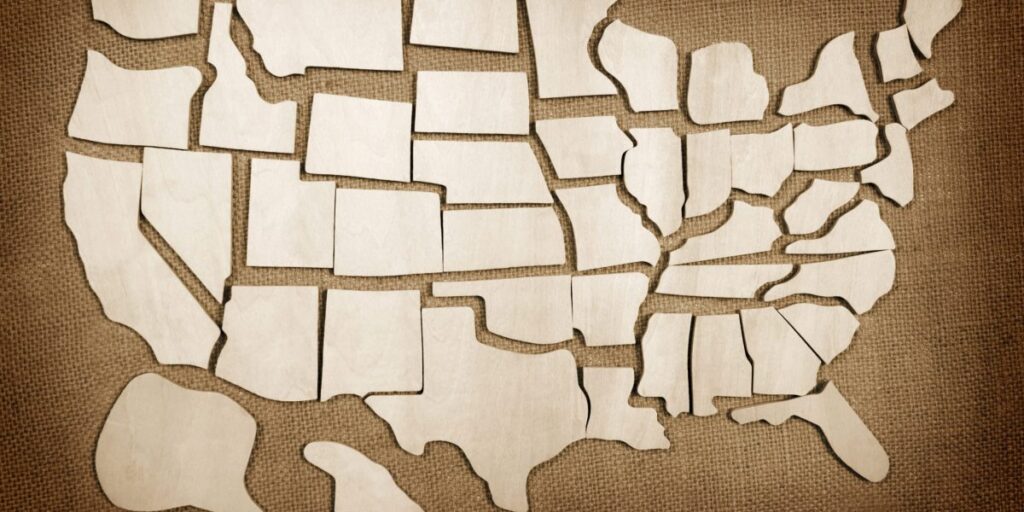
Economic Growth Slows as Nearly a Third of U.S. States Face Recession Risks
Warnings of an impending economic downturn grow louder as a significant portion of the United States’ economy shows signs of weakness. Mark Zandi, chief economist at Moody’s Analytics, highlights growing concerns about the stability of various states across the nation.
According to Zandi, states representing almost one-third of U.S. GDP are either in a recession or at high risk of entering one. Another third of the states are maintaining their current economic status, while the remaining third continue to experience growth. This nuanced landscape underscores the uneven economic recovery in different regions.
“States experiencing recessions are spread across the country, but the broader D.C. area stands out due to government job cuts,” Zandi explained. He emphasized that while Southern states are generally the strongest, their growth is slowing. The stability of California and New York, together accounting for over a fifth of U.S. GDP, remains crucial to preventing a national economic downturn.
The Atlanta Fed’s GDP tracker indicates that while nationwide growth is expected to continue, the rate is projected to drop to 2.3% in the third quarter from 3% in the second quarter.
State-Level Economic Breakdown
- Recession/high risk (22): Wyoming, Montana, Minnesota, Mississippi, Kansas, Massachusetts, Washington, Georgia, New Hampshire, Maryland, Rhode Island, Illinois, Delaware, Virginia, Oregon, Connecticut, South Dakota, New Jersey, Maine, Iowa, West Virginia, District of Columbia*.
- Treading water (13): Missouri, Ohio, Hawaii, New Mexico, Alaska, New York, Vermont, Arkansas, California, Tennessee, Nevada, Colorado, Michigan.
- Expanding (16): South Carolina, Idaho, Texas, Oklahoma, North Carolina, Alabama, Kentucky, Florida, Nebraska, Indiana, Louisiana, North Dakota, Arizona, Pennsylvania, Utah, Wisconsin.
Zandi further highlighted that the chances of a recession within the next year are at 49%, based on Moody’s machine-learning-based recession indicator. While fiscal measures like tax cuts and increased defense spending are expected to boost growth, their impact is not anticipated until the following year.
Employment figures raise additional concerns. Payrolls expanded by just 73,000 last month, falling short of the forecasted 100,000. Revisions for previous months have also been significantly lowered, suggesting that the average job gain over the past three months has dwindled to only 35,000. Zandi warned that ongoing revisions could indicate a decline in employment figures.
“Also telling is that employment is declining in many industries. In the past, if more than half the ≈400 industries in the payroll survey were shedding jobs, we were in a recession,” Zandi noted. Currently, over 53% of industries are reducing their workforce, with only the health care sector adding significantly to payrolls. The trend of more than half of industries shedding workers mirrors patterns seen in previous economic downturns.